
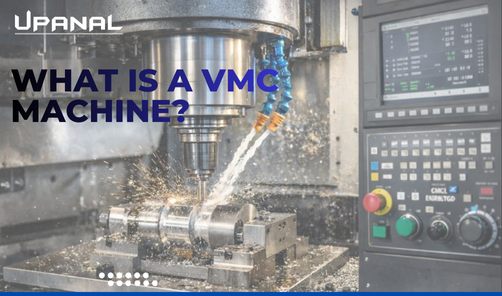
In today’s advanced manufacturing industry, precision, speed, and consistency are critical. One machine that plays a key role in achieving these requirements is the Vertical Machining Center (VMC). Widely used across industries, VMC machines have become an essential part of modern CNC machining operations.
In this blog, Upanal CNC explains what a VMC machine is, how it works, its axes, types, uses, machining processes, and industry applications.
What Is a VMC Machine?
A VMC (Vertical Machining Center), also known as a Vertical Milling Machine, is a CNC-controlled machine used for precision operations such as milling, drilling, tapping, boring, pocketing, and contour machining.
In a VMC machine:
- The spindle is oriented vertically
- The cutting tool moves along the Z-axis
- The workpiece is mounted on a table that moves along the X and Y axes
VMC machines are preferred when:
- Three-axis machining is required on a single face
- Applications involve moulds, dies, and precision components
- High accuracy, repeatability, and surface finish are critical
With advanced computerized CNC controls, modern VMCs offer automation, tool selection and change, contour control, and high repeatability—significantly improving productivity and machining quality.
How Does a VMC Machine Work?
A VMC operates using a CNC controller that follows programmed instructions (G-code). Once the program is loaded:
- The spindle rotates the cutting tool at high speed
- Material is removed layer by layer
- The machine automatically controls feed rate, spindle speed, axis movement, and tool changes
Key components of a VMC machine include:
- Vertical spindle
- CNC control system
- Worktable
- Automatic Tool Changer (ATC)
- Linear guideways or box guideways
How Many Axes Are in a VMC Machine?
Most standard VMC machines operate on three axes:
- X-axis: Left to right movement
- Y-axis: Front to back movement
- Z-axis: Vertical up and down movement
In standard VMCs, the cutter remains in the vertical direction. To increase machining capability:
- A 4th axis (rotary axis) can be added
- 5-axis VMC machines allow machining from multiple angles in a single setup, improving accuracy and reducing setup time
Types of VMC Machines
VMC machines are classified based on design, performance, and structure.
1. Classification Based on Guide Rail Type
Hard Rail VMC
- High rigidity and strength
- Suitable for heavy cutting operations
- Better vibration absorption
Linear Rail VMC
- Uses ball-bearing linear guideways
- Faster axis movement and higher sensitivity
- Ideal for high-speed and precision machining
2. Classification Based on Bed Structure
C-Type VMC
- Compact structure
- Suitable for small to medium components
- Widely used in job shops
Gantry-Type VMC
- Strong and rigid structure
- Ideal for large and heavy workpieces
- Used in heavy-duty machining applications
3. Classification Based on Spindle Speed
Low-Speed VMC
- Spindle speed: 6,000 – 15,000 RPM
- Suitable for general machining operations
High-Speed VMC
- Spindle speed: Above 18,000 RPM
- Provides excellent surface finish and high precision
- Ideal for mold, die, and aluminum machining
4. Classification Based on Column Structure
Fixed Column VMC
- Table moves while column remains fixed
- Accounts for over 75% of market usage
- Highly versatile and widely adopted
Fixed Worktable (Moving Column) VMC
- Column moves while table remains stationary
- Accounts for around 15% of the VMC market
- Used for specific large or heavy components
Machining Processes Performed on VMC Machines
VMC machines support a wide range of machining operations, including:
Milling
Creating flat, angled, or contoured surfaces using rotating cutting tools.
Drilling
Producing accurate holes with high positional accuracy.
Tapping
Automatic thread cutting operations.
Boring
Enlarging and finishing holes precisely.
Pocketing
Removing material from defined internal areas.
Contour Machining
Producing complex profiles and 3D shapes.
Advantages of Using a VMC Machine
- High accuracy and repeatability
- Reduced setup and cycle time
- Improved productivity
- Superior surface finish
- Lower operator dependency
- Suitable for batch and mass production
Industries Using VMC Machines
VMC machines are widely used in industries that demand precision, reliability, and consistency:
- Aerospace – structural and precision components
- Die & Mould – high-speed machining with excellent surface finish
- Medical – tight-tolerance components and instruments
- Defence – critical and high-accuracy parts
- Earth Moving & Heavy Equipment – durable and heavy-duty components
- Automotive & General Engineering
Applications of VMC Machining
VMC machines are used to machine materials such as:
- Aluminum
- Steel
- Stainless steel
- Cast iron
- Copper alloys
- Engineering plastics
Typical applications include:
- Mold and die manufacturing
- Brackets, bases, and housings
- Automotive and aerospace components
- Precision industrial parts
- Mass-production machining
Why Choose VMC Machines from Upanal CNC?
At Upanal CNC, we provide advanced and reliable VMC solutions designed for modern manufacturing needs. Our machines focus on:
- Rigid machine construction
- High-speed and high-torque spindles
- Precision guideways
- Reliable CNC controllers
- Professional installation, training, and service support
Not sure which VMC machine suits your requirement?
Upanal CNC experts are here to guide you.
Conclusion
A VMC machine is a versatile and powerful solution for precision machining across multiple industries. Understanding its types, axes, uses, and processes helps manufacturers choose the right machine for their production needs. With continuous advancements in CNC technology, VMC machines remain the backbone of modern manufacturing.
For expert CNC solutions and long-term support, Upanal CNC is your trusted partner.