
What Is a CNC Machine Health Checkup and Why Is It Important?
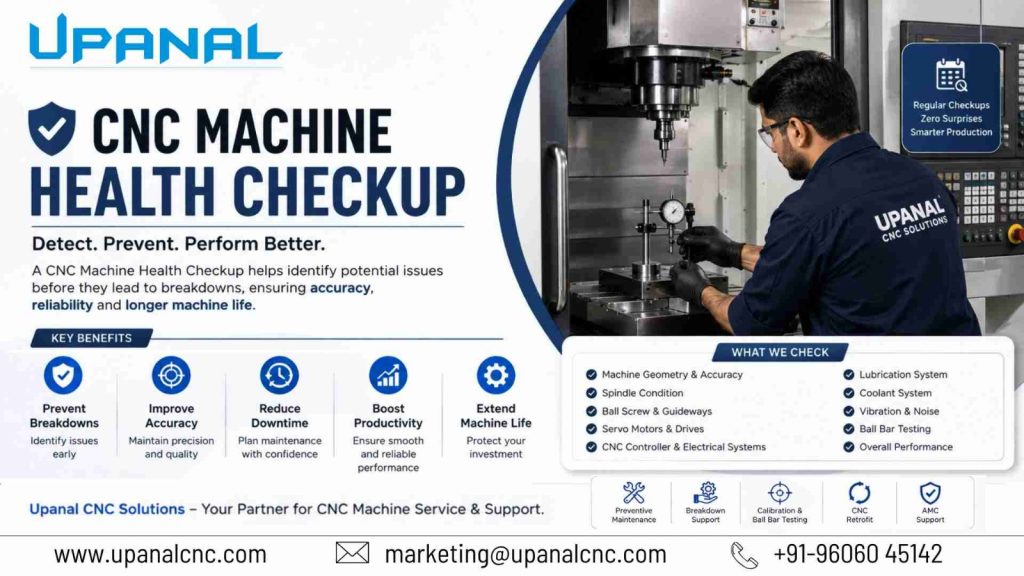
What Is a CNC Machine Health Checkup and Why Is It Important?
A CNC machine is a critical part of modern manufacturing. Even a small decline in machine accuracy, spindle performance, positioning, or mechanical condition can affect production quality and increase downtime.
Just like regular health checkups help identify problems before they become serious, a CNC Machine Health Checkup helps manufacturers identify potential machine issues before they lead to costly breakdowns.
In this article, we explain what a CNC machine health checkup involves, why it is important, and how regular machine inspection can improve productivity and machine life.
What Is a CNC Machine Health Checkup?
A CNC Machine Health Checkup is a systematic inspection and assessment of a CNC machine’s mechanical, electrical, control, and operational condition.
The objective is to determine the current health of the machine, identify potential problems, evaluate machine accuracy, and recommend corrective or preventive actions.
A professional health checkup may include:
- Machine geometry inspection
- Positioning accuracy verification
- Spindle condition assessment
- Ball screw and linear guideway inspection
- Servo motor and drive checking
- CNC controller and electrical system inspection
- Lubrication system inspection
- Coolant system inspection
- Vibration and abnormal noise checks
- Overall machine performance evaluation
Why Is a CNC Machine Health Checkup Important?
1. Prevents Unexpected Machine Breakdowns
Unexpected breakdowns can stop production and affect delivery schedules.
Regular health checks help identify early warning signs such as abnormal vibration, lubrication problems, servo errors, spindle issues, and mechanical wear.
Early identification allows manufacturers to plan maintenance before a major failure occurs.
2. Improves CNC Machine Accuracy
Machine accuracy can gradually deteriorate due to normal wear and operating conditions.
Issues with ball screws, linear guideways, machine geometry, spindle alignment, or positioning systems can affect component accuracy.
A professional inspection helps identify these problems and determine whether calibration, adjustment, repair, or retrofit is required.
3. Reduces Production Downtime
Unplanned downtime can be expensive for manufacturing companies.
Regular machine health assessments allow maintenance teams to identify potential problems and schedule corrective work during planned production stoppages.
This can significantly reduce the risk of unexpected downtime.
4. Extends Machine Life
Proper maintenance and timely correction of machine problems can help extend the useful life of CNC equipment.
Instead of waiting for a major component to fail, manufacturers can monitor machine condition and replace or repair components when necessary.
5. Improves Productivity
A well-maintained CNC machine can deliver better consistency, reliability, and production performance.
Maintaining machine accuracy and identifying performance issues early can help manufacturers maintain production standards and reduce rejected components.
What Is Checked During a CNC Machine Health Checkup?
A comprehensive CNC health checkup generally covers several important areas.
Mechanical Inspection
The mechanical condition of the machine is inspected for:
- Ball screw wear
- Linear guideway condition
- Backlash
- Machine geometry
- Mechanical looseness
- Abnormal noise
- Vibration
- Lubrication condition
Spindle Inspection
The spindle is one of the most important components of a CNC machine.
Inspection may include:
- Spindle runout
- Spindle vibration
- Bearing condition
- Spindle noise
- Temperature
- Tool holding condition
- Spindle performance
CNC Controller and Electrical System
The electrical and control systems are checked for potential problems, including:
- CNC controller alarms
- Servo drive alarms
- Servo motor condition
- Electrical panel condition
- Cooling system
- Wiring and connections
- Battery and backup systems
- PLC-related issues
Accuracy and Geometry Checks
Machine accuracy plays an important role in component quality.
Depending on the machine and requirement, inspection may include:
- Positioning accuracy
- Repeatability
- Straightness
- Squareness
- Parallelism
- Leveling
- Spindle alignment
- Ball bar testing
These checks can help identify deviations that may not be visible during normal machine operation.
Ball Bar Testing for CNC Machines
Ball Bar Testing is an important diagnostic method used to evaluate the positioning performance and geometric condition of CNC machine tools.
It can help identify issues related to:
- Backlash
- Servo performance
- Positioning errors
- Circular interpolation
- Machine geometry
- Axis performance
The results can provide valuable information about the condition of the machine and help engineers determine appropriate corrective actions.
How Often Should a CNC Machine Health Checkup Be Performed?
The ideal frequency depends on factors such as:
- Machine age
- Production hours
- Machine utilization
- Type of machining operation
- Required accuracy
- Operating environment
- Maintenance history
For heavily used machines, regular inspections can help detect wear and performance deterioration at an early stage.
Manufacturers should also consider conducting a health checkup when:
- Machine accuracy has reduced
- Surface finish has deteriorated
- Unusual vibration or noise is noticed
- Servo alarms are increasing
- Production rejection has increased
- The machine has experienced repeated breakdowns
- A major retrofit or upgrade is being considered
CNC Machine Health Checkup vs Preventive Maintenance
Although they are related, a machine health checkup and preventive maintenance are not exactly the same.
Preventive Maintenance focuses on planned maintenance activities such as lubrication, cleaning, inspection, replacement of consumables, and scheduled servicing.
A Machine Health Checkup focuses more on evaluating the overall condition and performance of the machine and identifying areas that may require attention.
Combining both approaches can provide a more effective machine maintenance strategy.
When Should You Consider CNC Retrofitting?
A health checkup can also help determine whether a machine is a good candidate for CNC Retrofit.
Retrofitting may be considered when:
- The existing CNC control is outdated
- Spare parts are difficult to obtain
- Machine accuracy has deteriorated
- Servo systems require upgrading
- Electrical systems are obsolete
- Production requirements have increased
- The machine structure is still mechanically suitable
Instead of completely replacing a machine, a suitable retrofit can modernize important systems and potentially extend the machine’s productive life.
Benefits of Regular CNC Machine Health Monitoring
Regular machine health monitoring can help manufacturers:
✔ Reduce unexpected breakdowns
✔ Improve machine accuracy
✔ Reduce maintenance costs
✔ Increase machine availability
✔ Improve production consistency
✔ Extend machine life
✔ Plan maintenance activities
✔ Identify retrofit requirements
✔ Reduce production losses
Why Choose Professional CNC Service?
A CNC machine is a complex combination of mechanical, electrical, electronic, and control systems. Professional inspection helps ensure that potential problems are evaluated correctly.
An experienced CNC service team can assess machine condition, identify the root cause of performance issues, and recommend suitable solutions such as preventive maintenance, calibration, repair, retrofit, or component replacement.
Conclusion
A CNC Machine Health Checkup is an important part of maintaining machine performance and production reliability.
Regular inspection can help manufacturers identify potential problems before they develop into major failures. It can also provide valuable information about machine accuracy, component condition, maintenance requirements, and the need for future upgrades.
For manufacturers looking to reduce downtime, improve CNC machine performance, and extend machine life, regular machine health assessments can be a valuable part of an overall maintenance strategy.
Need a CNC Machine Health Checkup?
Upanal CNC Solutions provides professional CNC service and maintenance solutions, including Machine Health Checkup, Preventive Maintenance, AMC, Breakdown Support, Calibration, Ball Bar Testing and CNC Retrofit Solutions.
Contact our team to schedule a CNC machine health assessment and understand the current condition of your machine.
Upanal CNC Solutions – Your Partner for CNC Machine Service & Support.
Frequently Asked Questions
1. What is a CNC Machine Health Checkup?
A CNC Machine Health Checkup is a detailed inspection of a CNC machine’s mechanical, electrical, control, accuracy, and operational condition.
2. How often should a CNC machine be inspected?
Inspection frequency depends on machine usage, age, production requirements, operating conditions, and maintenance history.
3. What is checked during a CNC health checkup?
It can include machine geometry, spindle condition, ball screws, linear guideways, servo systems, CNC controls, electrical systems, lubrication, coolant systems, and machine accuracy.
4. Can a health checkup prevent CNC machine breakdowns?
It can help identify potential problems at an early stage, allowing manufacturers to plan corrective or preventive maintenance before a major failure occurs.
5. What is the difference between CNC health checkup and AMC?
A health checkup evaluates the overall condition and performance of a machine, while an AMC provides scheduled service and maintenance support over an agreed period.
6. When should a CNC machine be considered for retrofit?
Retrofit may be considered when the machine is mechanically suitable but has outdated controls, drives, electrical systems, or other technologies that affect performance and supportability.