
How to Select the Right Press Brake Tonnage for Your Application
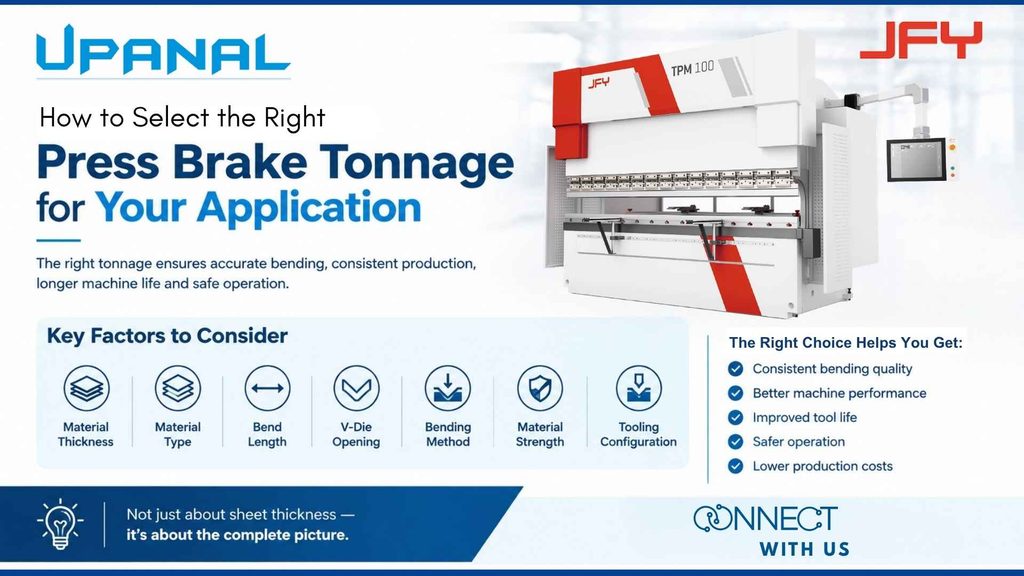
Choosing the right press brake tonnage is one of the most important decisions when setting up or upgrading a sheet metal bending operation. The correct tonnage ensures accurate bending, consistent production, longer machine life, and safe operation.
Selecting a press brake simply based on the thickness of the sheet is not enough. Material type, bend length, tooling, bending method, and V-die opening all influence the required bending force.
In this guide, we explain the key factors to consider when selecting the right press brake tonnage for your application.
What Is Press Brake Tonnage?
Press brake tonnage refers to the maximum amount of force a press brake can apply during the bending process. It is generally expressed in tons.
For example, a 100-ton press brake can apply approximately 100 tons of maximum bending force under its rated conditions.
The required tonnage depends on the combination of:
- Material type
- Material thickness
- Bend length
- V-die opening
- Bending method
- Material strength
- Tooling configuration
A machine with insufficient tonnage may not be able to complete the bend properly, while selecting a machine with significantly more capacity than required can increase equipment and operating costs.
Why Is Choosing the Correct Tonnage Important?
The right press brake capacity helps manufacturers achieve:
1. Consistent Bending Quality
Adequate bending force helps maintain consistent bend angles and dimensions throughout production.
2. Better Machine Performance
Operating within the recommended tonnage range reduces unnecessary stress on the machine’s frame, hydraulic system, tooling, and other components.
3. Improved Tool Life
Using appropriate tooling and bending force helps reduce excessive wear on punches and dies.
4. Safer Operation
Correct machine and tooling selection reduces the risk associated with overloading the press brake.
5. Lower Production Costs
The correct machine can improve productivity while avoiding unnecessary investment in excessive machine capacity.
Key Factors That Determine Press Brake Tonnage
1. Material Thickness
Material thickness is one of the most important factors.
Generally, thicker sheets require greater bending force. For example, bending a 3 mm mild-steel sheet will require considerably less force than bending a 10 mm sheet of the same material.
However, thickness alone should never be used to determine machine tonnage.
2. Material Type
Different materials have different tensile strengths and therefore require different bending forces.
Common materials processed on press brakes include:
- Mild Steel
- Stainless Steel
- Aluminium
- Copper
- High-strength steel
For the same thickness and bend length, stainless steel typically requires more bending force than mild steel, while aluminium generally requires less.
Therefore, the material’s mechanical properties must be considered when calculating tonnage.
3. Bend Length
The longer the bend, the greater the bending force required.
For example, bending a 1-metre section and bending a 3-metre section using otherwise similar conditions will require significantly different force.
This is why press brake specifications commonly include machine length along with tonnage, such as:
100T × 2500 mm
Here:
- 100T = maximum rated bending force
- 2500 mm = maximum bending length
Both specifications are important when selecting a machine.
4. V-Die Opening
The V-die opening has a major influence on the required bending force.
In air bending, a larger V-die opening generally reduces the required bending force, while a smaller opening increases the force.
However, choosing a die opening is not simply about selecting the largest possible V-opening. The tooling must also be appropriate for:
- Material thickness
- Bend radius
- Flange dimensions
- Required bend angle
- Part geometry
The correct combination of punch and die is essential for achieving consistent results.
Understanding Air Bending, Bottom Bending and Coining
The bending method also affects the required tonnage.
Air Bending
The sheet is supported by the shoulders of the V-die while the punch partially enters the opening.
Air bending generally requires less force than bottom bending or coining.
Bottom Bending
The material is pressed more firmly against the bottom of the die. It generally requires more force than air bending.
Coining
Coining involves very high force to plastically deform the material through the full thickness. It requires significantly higher tonnage than air bending.
For many modern fabrication applications, air bending is widely used because it provides flexibility and requires comparatively lower bending force.
Basic Press Brake Tonnage Calculation
A commonly used formula for estimating air-bending force for mild steel is:
F = (1.42 × TS × L × T²) / V
Where:
- F = bending force in tons
- TS = tensile strength of the material
- L = bend length
- T = material thickness
- V = V-die opening
The exact formula and constants can vary depending on the manufacturer’s calculation method and units used.
Therefore, tonnage charts supplied by the press brake manufacturer should always be used for final machine selection.
Example: Estimating Required Tonnage
Consider a mild-steel sheet with:
- Thickness: 6 mm
- Bend length: 2500 mm
- V-die opening: 48 mm
The required bending force can be estimated using the appropriate tonnage chart or manufacturer’s calculation method.
The result should then be compared with available machine capacities.
For production planning, it is advisable to maintain an appropriate capacity margin rather than selecting a machine that operates continuously at its absolute maximum rated tonnage.
Don’t Select a Press Brake Based Only on Tonnage
A common mistake is to think:
“Thicker sheet = Buy a higher-tonnage machine.”
In reality, press brake selection involves much more than tonnage.
You should also evaluate:
Machine Length
Make sure the working length is sufficient for your largest components.
Stroke
The available stroke should accommodate the required bending depth and tooling arrangement.
Daylight
Adequate daylight is important when producing deep or complex components.
Throat Depth
A suitable throat depth provides sufficient clearance for larger components.
Back Gauge
A reliable CNC back gauge improves positioning accuracy and repeatability.
CNC Control
Modern CNC controls can simplify programming, improve productivity, and reduce setup time.
Tooling Compatibility
Ensure the machine supports the tooling required for your applications.
How to Choose the Right Press Brake for Your Production
Before purchasing a press brake, prepare a list of your typical and maximum production requirements.
Consider:
1. What is the maximum material thickness?
Identify the thickest material you regularly process.
2. What materials do you bend?
Record the common materials and their mechanical properties.
3. What is the maximum bend length?
Select a machine with sufficient working length.
4. What type of bending do you use?
Determine whether your applications require air bending, bottom bending, or coining.
5. What are your production volumes?
Higher production volumes may justify a faster CNC press brake with advanced automation features.
6. What components do you manufacture?
Complex parts may require additional axes, advanced back gauges, or specialised tooling.
7. What are your future requirements?
Selecting a machine only for today’s requirements may limit future production capabilities.
Why CNC Press Brake Technology Matters
Modern CNC press brakes provide much more than basic bending force.
Advanced systems can provide:
- CNC-controlled back gauges
- Programmable bending sequences
- Automatic compensation systems
- Improved angle control
- Touchscreen operation
- Tooling management
- Collision avoidance features
- 3D part programming
- Better repeatability
These features can significantly reduce setup time and improve production consistency.
For manufacturers producing a wide range of components, CNC control can make a major difference in productivity.
Common Mistakes When Selecting Press Brake Tonnage
Choosing Based Only on Sheet Thickness
Thickness is important, but material strength, bend length, tooling, and bending method must also be considered.
Ignoring Future Production Requirements
A machine that is adequate today may become a limitation as production requirements increase.
Using the Wrong V-Die
An unsuitable V-die can increase bending force and negatively affect bend quality.
Operating at Maximum Capacity Continuously
A press brake should be selected with the actual production requirements and recommended operating limits in mind.
Ignoring Tooling Requirements
The machine should be compatible with the punches, dies, and tooling systems required for your components.
Press Brake Tonnage Selection: A Quick Checklist
Before finalising your machine, check:
☑ Maximum material thickness
☑ Material type and strength
☑ Maximum bend length
☑ Required V-die opening
☑ Bending method
☑ Required bending radius
☑ Machine tonnage
☑ Machine working length
☑ Stroke and daylight
☑ Throat depth
☑ CNC back gauge requirements
☑ Tooling compatibility
☑ Production volume
☑ Future expansion requirements
Choose Capacity Based on Your Application
There is no single press brake tonnage that is ideal for every manufacturer.
A fabrication workshop producing thin sheet-metal components may require a completely different machine from a heavy engineering company working with thick plates.
The right approach is to first understand your material, thickness, bend length, tooling, production volume, and future requirements, and then select the appropriate press brake capacity.
With the right machine, manufacturers can achieve better bending accuracy, higher productivity, improved repeatability, and more efficient production.
Looking for the Right CNC Press Brake?
At Upanal CNC, we provide complete metal forming solutions for modern manufacturing requirements.
Our JFY CNC Press Brake solutions are designed to deliver precision, productivity, intelligent control, and reliable performance for a wide range of sheet metal bending applications.
From machine selection and installation to service and ongoing support, Upanal can support your production journey with a complete solution.
Upanal CNC × JFY
Precision Bending. Smarter Production. Better Results.
One Partner. Total Metal Solutions.