
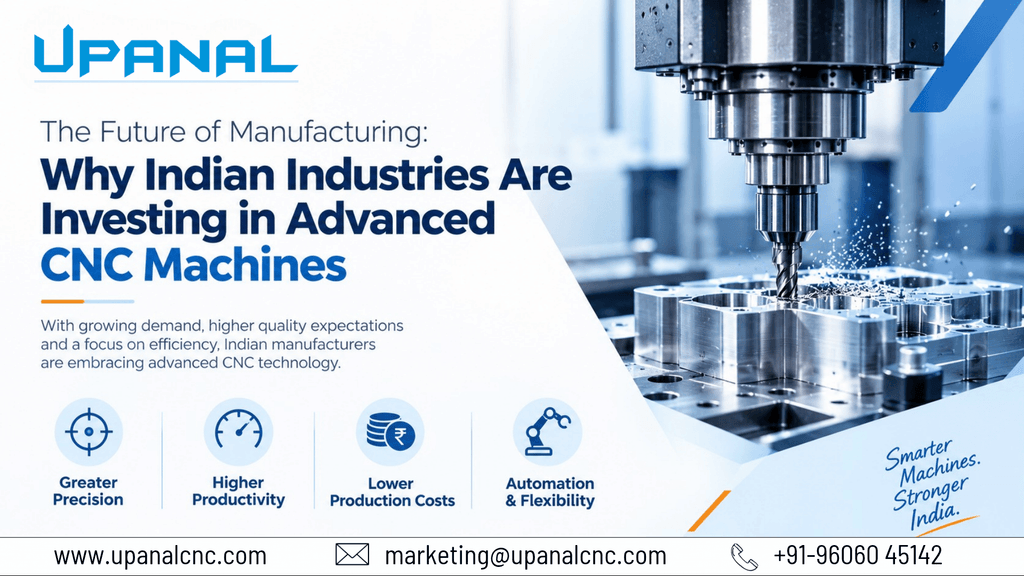
The Future of Manufacturing: Why Indian Industries Are Investing in Advanced CNC Machines
Introduction
India’s manufacturing sector is undergoing a significant transformation. Growing industrial demand, evolving customer expectations, increasing competition, and the need for higher product quality are encouraging manufacturers to adopt advanced production technologies.
Today, manufacturing businesses must deliver components faster, maintain consistent quality, reduce production costs, and respond to changing market requirements. To achieve these goals, many industries are investing in advanced CNC (Computer Numerical Control) machines.
From automotive and aerospace to defence, railways, die and mould, medical equipment, and general engineering, CNC machining has become an important part of modern manufacturing. Advanced CNC machines enable manufacturers to handle complex components, improve machining consistency, and optimise production processes.
As India strengthens its position as a global manufacturing destination, the adoption of modern CNC technology is expected to remain an important factor in industrial growth.
1. Growing Demand for Precision Manufacturing
Precision is one of the most important requirements in modern manufacturing. Components must meet specified dimensions, tolerances, and surface-finish requirements to function reliably in their intended applications.
Industries such as aerospace, automotive, defence, and medical equipment manufacturing often require components with demanding dimensional requirements. Even small deviations can lead to assembly difficulties, quality rejection, or performance issues.
Advanced CNC machines use programmed movements and controlled machining operations to produce components with high repeatability. With suitable tooling, workholding, cutting parameters, and machine maintenance, manufacturers can achieve consistent machining results across production batches.
Investing in the right CNC technology helps businesses improve process control, reduce dimensional variation, and meet increasingly demanding quality expectations.
2. Higher Productivity and Reduced Machining Time
Production efficiency directly affects a manufacturing business’s ability to meet delivery commitments and manage operating costs. Long machining cycles, frequent tool changes, repeated setups, and unnecessary machine downtime can reduce overall productivity.
Modern CNC machines are designed to support efficient machining through features such as high-speed spindles, rapid axis movement, automatic tool changers, and optimised machining cycles.
For suitable applications, these features can help reduce non-cutting time and improve machine utilisation. For example, an automatic tool changer can minimise the time required to switch between cutting tools during a programmed operation.
By selecting a machine that matches the component geometry, material, tooling requirements, and production volume, manufacturers can improve throughput while maintaining the required quality standards.
3. Automation Is Transforming Manufacturing
Automation is becoming an important part of modern industrial production. Manufacturers are looking for ways to streamline repetitive operations, reduce manual intervention, and improve production consistency.
Advanced CNC machines support automation through programmable machining cycles, automatic tool changing, probing systems, and integration with suitable material-handling or production systems.
Depending on the application, automation can help manufacturers reduce setup variation, improve workflow consistency, and make better use of available production time.
However, successful automation requires more than purchasing advanced equipment. Manufacturers must also consider process planning, tooling, operator capability, production scheduling, and integration with existing systems.
A well-planned automation strategy can help businesses build a more efficient and scalable manufacturing operation.
4. Meeting the Requirements of Different Industries
Different manufacturing sectors have different machining requirements. Selecting the appropriate CNC technology is essential for achieving the desired combination of precision, productivity, and flexibility.
Automotive Industry
Automotive manufacturing requires consistent quality and efficient production of components such as housings, brackets, shafts, and transmission parts. CNC machining centres and turning machines can support repeatable production and help manufacturers meet demanding cycle-time requirements.
Aerospace and Defence
Aerospace and defence applications often involve complex geometries, specialised materials, and demanding inspection requirements. Advanced machining centres, including suitable five-axis configurations, can help manufacturers machine complex features and reduce the number of setups required for certain components.
Die and Mould Manufacturing
Die and mould production requires accurate machining of intricate profiles, cavities, and contours. High-performance CNC machining centres help manufacturers achieve the precision and surface quality needed for demanding tooling applications.
Railways
Railway manufacturing and maintenance involve a variety of mechanical components that require reliable machining and dimensional accuracy. Appropriate CNC turning and machining solutions can support the production of parts used in railway equipment and related industrial applications.
General Engineering
General engineering businesses often manufacture a wide variety of components in different sizes, materials, and quantities. Flexible CNC machines enable these manufacturers to handle diverse machining requirements while maintaining repeatability and production efficiency.
Medical Equipment Manufacturing
Certain medical equipment and device components require precise dimensions, controlled surface finishes, and consistent manufacturing processes. Suitable CNC technology can support these requirements, subject to the applicable material, validation, and quality standards.
5. The Shift Towards Multi-Axis Machining
As product designs become more complex, manufacturers are increasingly evaluating multi-axis CNC machining solutions.
Three-axis machining remains suitable for many standard components. However, components with angled features, complex contours, and multiple machining faces may benefit from four-axis or five-axis machining.
Five-axis CNC machines can coordinate movement across multiple axes, allowing suitable components to be machined from different orientations in a single setup. This can reduce repositioning, improve access to complex features, and help maintain the relationship between machined surfaces.
Horizontal machining centres can also offer advantages for certain multi-face machining applications, while vertical turning machines are suitable for many large-diameter or heavy components.
The right solution depends on component geometry, material, tolerances, production volume, tooling strategy, and investment requirements. Not every component requires multi-axis machining, so manufacturers should evaluate the actual production benefits before investing.
6. Improved Consistency and Quality Control
Manufacturing quality depends on the ability to produce components that consistently meet specifications. Variation can arise from tool wear, thermal changes, machine condition, workholding, cutting parameters, and operator practices.
Modern CNC machines provide repeatable programmed operations, helping manufacturers maintain greater consistency when processes are properly developed and controlled.
Additional technologies, such as tool measurement, workpiece probing, and in-process inspection systems, can help detect certain errors and reduce the risk of producing non-conforming components.
Nevertheless, CNC technology alone does not guarantee quality. Correct programming, suitable cutting tools, stable fixtures, calibrated measuring equipment, and preventive maintenance remain essential for reliable results.
Combining advanced machinery with effective quality-control practices helps manufacturers reduce avoidable rework and improve confidence in their production processes.
7. Better Utilisation of Materials and Resources
Efficient manufacturing involves more than increasing machine speed. Businesses must also manage raw materials, cutting tools, energy consumption, coolant, and production waste.
Optimised toolpaths and appropriate cutting parameters can reduce unnecessary machining movements and help extend tool life in suitable applications. Accurate process planning can also minimise material waste, particularly when working with expensive materials or complex components.
Machine selection plays an important role as well. A machine that is appropriately sized and configured for the intended workload can help avoid unnecessary investment and inefficient operation.
Manufacturers should assess total operating requirements, including energy use, tooling costs, maintenance, consumables, and expected production output, rather than evaluating machines solely on their purchase price.
8. The Importance of Reliable CNC Machine Support
Investing in advanced CNC equipment is only one part of building an efficient manufacturing operation. Long-term performance also depends on machine condition, maintenance planning, technical assistance, and the availability of appropriate service support.
Unexpected breakdowns can interrupt production schedules, delay deliveries, and increase operating costs. Preventive maintenance and timely technical intervention can help identify potential problems before they lead to extended downtime.
Manufacturers should consider the availability of service engineers, spare parts, controller support, and maintenance assistance when evaluating CNC machine investments.
A reliable support arrangement can help businesses maintain machine performance throughout its operating life and plan production with greater confidence.
9. How to Choose the Right Advanced CNC Machine
Selecting a CNC machine requires a clear understanding of current production needs and future business objectives. A machine with impressive specifications may not necessarily be the most suitable option for every application.
Before investing, manufacturers should evaluate the following factors:
- Component requirements: Review part dimensions, material, geometry, tolerances, and surface-finish expectations.
- Production volume: Determine whether the requirement is for prototype work, small batches, or high-volume production.
- Machine configuration: Compare VMCs, HMCs, turning machines, vertical turning machines, and multi-axis solutions based on the intended application.
- Spindle and tooling requirements: Check spindle speed, torque, power, tool capacity, and compatibility with the planned machining processes.
- Productivity expectations: Evaluate realistic cycle times, setup requirements, and machine utilisation.
- Service and maintenance: Consider technical support, spare-parts availability, and preventive maintenance requirements.
- Future expansion: Select a configuration that can support expected changes in component design, production volume, and manufacturing capabilities.
A detailed application assessment can help manufacturers choose equipment that delivers practical value and supports long-term production goals.
10. New CNC Machines and Manufacturing Modernisation
As production requirements evolve, manufacturers may need to expand their machining capacity, replace ageing equipment, or introduce new capabilities.
Investing in a new CNC machine can provide access to modern controls, improved machine configurations, advanced tooling options, and features suited to current production requirements. This can be particularly valuable when existing equipment cannot meet required tolerances, productivity targets, or component complexity.
At the same time, the most suitable investment depends on the business’s existing assets and production objectives. Manufacturers should compare machine capabilities, operating costs, expected output, and long-term support before making a decision.
A well-planned investment strategy helps businesses align their equipment with customer expectations and future manufacturing opportunities.
Conclusion
The future of Indian manufacturing will increasingly depend on precision, productivity, automation, and the ability to adapt to evolving industry requirements. Advanced CNC machines are helping manufacturers produce complex components, improve process consistency, and respond to growing demands across multiple sectors.
However, successful manufacturing modernisation requires more than advanced equipment. The right machine configuration, effective process planning, skilled operators, quality-control practices, and dependable technical support all contribute to long-term performance.
For manufacturers planning to expand capacity or modernise their operations, choosing the right CNC solution is an important step towards building a competitive and future-ready business.
Upanal CNC Solutions LLP offers CNC machine solutions, including VMCs, HMCs, five-axis machining centres, turning machines, vertical turning machines, and sheet metal processing equipment. With machine service and technical support, Upanal helps manufacturers explore solutions suited to their production requirements.
Upanal CNC Solutions — One Partner. Total Metal Solutions.