
Predictive Maintenance vs Preventive Maintenance in CNC Manufacturing
Introduction
In modern manufacturing, CNC machines play a critical role in maintaining production quality, accuracy and efficiency. However, unexpected machine breakdowns, component failures and unplanned downtime can affect productivity and increase operating costs.
To keep CNC machines running efficiently, manufacturers rely on different maintenance strategies. Two of the most commonly used approaches are Preventive Maintenance (PM) and Predictive Maintenance (PdM).
Although both approaches aim to reduce machine failures and improve equipment reliability, they work in different ways.
Understanding the difference between predictive and preventive maintenance can help manufacturers choose the right maintenance strategy for their CNC machines.
What Is Preventive Maintenance?
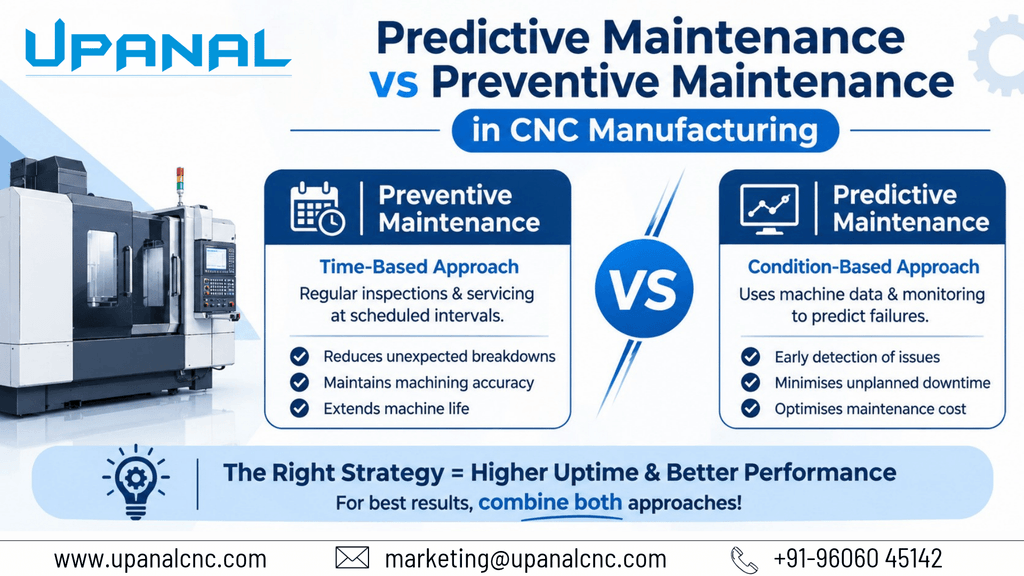
Preventive Maintenance (PM) is a planned maintenance approach where machines are inspected, serviced and maintained at regular intervals, regardless of their current operating condition.
The objective is to identify potential issues early and prevent unexpected breakdowns.
Preventive maintenance activities for CNC machines typically include:
- Regular inspection of machine components.
- Lubrication of guideways, ball screws and moving parts.
- Checking hydraulic and pneumatic systems.
- Cleaning filters, coolant tanks and machine enclosures.
- Inspecting electrical connections and control panels.
- Checking spindle condition and tool holders.
- Verifying machine alignment and operating accuracy.
Example: A CNC machining center may undergo scheduled maintenance every three months or after a specified number of operating hours to ensure that all critical components are functioning properly.
What Is Predictive Maintenance?
Predictive Maintenance (PdM) is a condition-based maintenance approach that uses machine data, sensors and monitoring technologies to identify potential equipment failures before they occur.
Instead of following fixed maintenance schedules, predictive maintenance evaluates the actual condition and performance of machine components.
It helps manufacturers understand when maintenance is required based on equipment health.
Predictive maintenance activities may include:
- Spindle vibration monitoring.
- Temperature monitoring of critical components.
- Motor current and load analysis.
- Monitoring spindle bearing conditions.
- Hydraulic pressure monitoring.
- Analysing machine alarms and operating data.
- Using advanced analytics to identify abnormal machine behaviour.
Example: If vibration monitoring detects unusual spindle behaviour, maintenance can be scheduled before the spindle develops a major fault or causes production interruptions.
Predictive Maintenance vs Preventive Maintenance: Key Differences
Both maintenance strategies help improve CNC machine reliability, but their approaches are different.
| Parameter | Preventive Maintenance | Predictive Maintenance |
| Approach | Time-based or usage-based | Condition-based |
| Maintenance timing | Scheduled intervals | Based on machine condition |
| Monitoring | Regular inspections | Sensors and machine data |
| Failure detection | Identifies potential issues during scheduled checks | Detects abnormal conditions and trends |
| Technology | Maintenance schedules and checklists | Sensors, monitoring and analytics |
| Cost | Planned maintenance expenses | Investment in monitoring technology |
| Best suited for | Most CNC machines | Critical machines and high-production environments |
Benefits of Preventive Maintenance in CNC Machines
Preventive maintenance is an essential part of maintaining CNC machine performance.
1. Reduces Unexpected Breakdowns
Regular inspections and servicing help identify worn-out components and potential problems before they lead to machine failures.
2. Improves Machine Life
Proper lubrication, cleaning and periodic inspection help reduce unnecessary wear and tear on machine components.
3. Maintains Machining Accuracy
Regular checking of machine alignment, spindle condition and mechanical components helps maintain machining precision.
4. Reduces Repair Costs
Identifying minor issues early can prevent expensive component failures and major repairs.
5. Improves Production Planning
Scheduled maintenance allows manufacturers to plan machine servicing without significantly affecting production schedules.
Benefits of Predictive Maintenance in CNC Machines
Predictive maintenance takes machine monitoring a step further by analysing equipment performance and identifying early warning signs.
1. Early Detection of Machine Problems
Continuous or periodic condition monitoring helps detect unusual vibration, temperature changes and abnormal operating conditions.
2. Minimises Unplanned Downtime
Maintenance can be planned based on actual machine conditions, reducing the possibility of sudden production interruptions.
3. Optimises Maintenance Activities
Instead of replacing components only according to fixed schedules, manufacturers can make maintenance decisions based on equipment condition.
4. Improves Equipment Reliability
Monitoring critical machine components helps manufacturers identify developing problems and take corrective action.
5. Supports Smart Manufacturing
Predictive maintenance can be integrated with digital monitoring systems and Industry 4.0 technologies to improve production visibility.
Which Maintenance Strategy Is Better for CNC Manufacturing?
There is no single maintenance strategy that works best for every manufacturing facility.
The right approach depends on machine usage, production requirements, machine criticality and available monitoring technology.
- Preventive Maintenance: Suitable for manufacturers who want a structured maintenance schedule and regular inspection of their CNC machines.
- Predictive Maintenance: Suitable for high-production facilities where machine downtime can significantly affect manufacturing operations and where condition-monitoring technology is available.
For many manufacturers, combining both approaches provides the best results.
Preventive maintenance ensures that routine servicing is completed on time, while predictive maintenance provides additional insights into the actual condition of critical machine components.
How Upanal CNC Supports CNC Machine Performance
At Upanal CNC, we understand that machine performance and reliability are essential for uninterrupted manufacturing operations.
We support manufacturers with comprehensive CNC machine solutions, including machine installation, technical support, servicing and Annual Maintenance Contracts (AMC).
Our service approach focuses on:
- Periodic machine inspection and maintenance.
- Mechanical and electrical troubleshooting.
- Spindle and machine component inspection.
- Lubrication and hydraulic system checks.
- Machine performance evaluation.
- Technical support to reduce unexpected downtime.
Through structured maintenance support and technical expertise, Upanal CNC helps manufacturers maintain machine reliability, improve production efficiency and extend equipment life.
Conclusion
Both preventive and predictive maintenance play important roles in modern CNC manufacturing.
Preventive maintenance helps prevent failures through regular servicing and inspection, while predictive maintenance uses machine condition data to identify potential problems before they become major failures.
By adopting the right combination of maintenance strategies, manufacturers can reduce downtime, control maintenance costs and improve overall equipment performance.
Looking for reliable CNC machine service and maintenance support?
Connect with Upanal CNC for professional CNC machine servicing, technical support and Annual Maintenance Contract (AMC) solutions.
Upanal CNC – One Partner. Total Metal Solutions.