
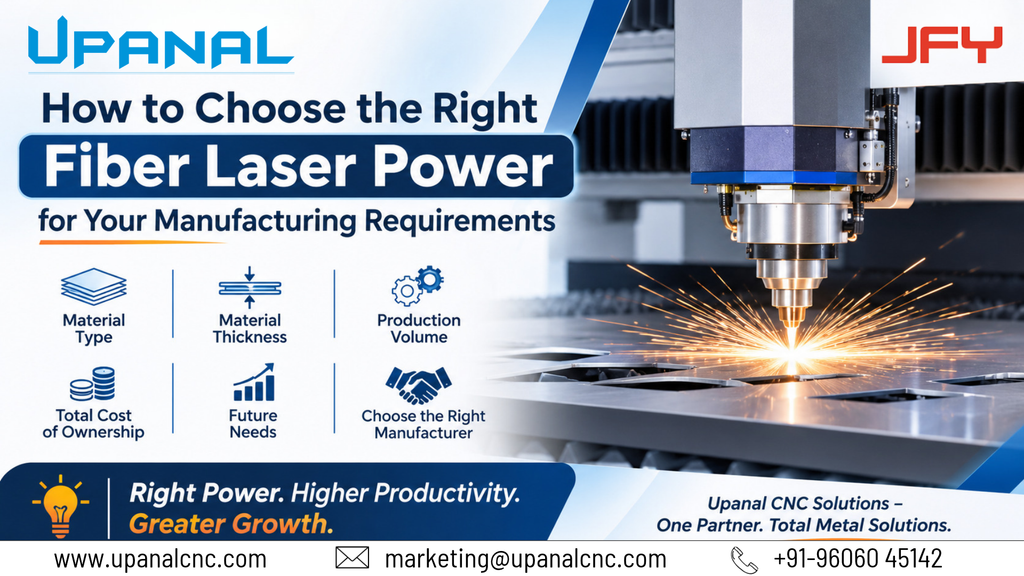
How to Choose the Right Fiber Laser Power for Your Manufacturing Requirements
Introduction
Choosing the right fiber laser cutting machine is an important decision for any sheet metal manufacturing business. One of the most critical factors to consider is laser power, measured in kilowatts (kW).
Fiber laser machines are available in different power configurations, such as 1.5 kW, 3 kW, 6 kW, 12 kW and higher. Selecting the right power depends on material type, sheet thickness, production volume, cutting speed and overall manufacturing requirements.
Choosing a machine with insufficient power may limit productivity, while investing in unnecessarily high laser power can increase equipment and operating costs.
In this guide, we will explore the key factors to consider when selecting the right fiber laser power for your business.
1. Understand the Relationship Between Laser Power and Cutting Performance
Laser power directly influences the cutting capability and performance of a fiber laser machine.
Generally, higher laser power offers:
- Greater cutting capacity for thicker materials.
- Higher cutting speeds, particularly on suitable material thicknesses.
- Improved productivity in demanding production environments.
- Greater flexibility across different material thicknesses.
However, cutting performance also depends on beam quality, cutting head specifications, assist gas, nozzle selection and machine configuration.
2. Consider the Material You Plan to Cut
Different materials respond differently to fiber laser cutting technology.
Common materials include:
Mild Steel: Widely used in fabrication, structural components, automotive parts and industrial equipment.
Stainless Steel: Commonly used in food processing equipment, medical equipment, enclosures and architectural applications.
Aluminium: Used in electrical enclosures, automotive components and lightweight structures.
Brass and Copper: Used in electrical components, busbars and specialised industrial applications.
Before selecting laser power, identify the materials your business processes regularly.
3. Identify Your Required Material Thickness
Material thickness is one of the most important factors when selecting laser power.
Higher laser power generally allows manufacturers to process thicker materials and achieve higher cutting speeds.
For example, manufacturers working primarily with thin sheet metal may have different power requirements from businesses processing heavy industrial plates.
The following table provides a general selection guide:
| Laser power | Typical applications |
| 1.5 kW–2 kW | Thin sheet metal cutting |
| 3 kW | General fabrication and medium-thickness sheets |
| 6 kW | Higher productivity and thicker material processing |
| 12 kW | Heavy-duty industrial cutting |
| 20 kW and above | High-capacity industrial cutting applications |
Note: These are broad application categories, not guaranteed cutting-thickness limits. Actual capacity depends on material grade, thickness, machine configuration and cutting parameters.
4. Evaluate Your Production Volume and Cutting Speed
Laser power selection should also depend on your daily production requirements.
Consider the following questions:
- How many components do you manufacture per shift?
- What is your average sheet thickness?
- How many different materials do you process?
- Do you require faster production turnaround?
- Are you planning to expand production capacity?
For high-volume manufacturing, higher laser power may help reduce cutting time and improve overall productivity.
For small-scale fabrication and job-work operations, a properly configured lower-power machine may provide better value.
5. Consider the Total Cost of Ownership
Buying a fiber laser cutting machine is not just about the initial investment.
Manufacturers should also consider:
- Electricity consumption.
- Assist gas consumption.
- Nozzle and protective lens replacement.
- Preventive maintenance.
- Operator requirements.
- Service availability and spare parts.
The objective should be to select a machine that delivers the right balance between investment, productivity and operating costs.
6. Choose a Machine That Supports Future Production Requirements
Your current manufacturing requirements may change as your business grows.
Consider whether your future plans include:
- Processing thicker materials.
- Expanding into new industries.
- Increasing production capacity.
- Taking up larger fabrication orders.
- Improving automation and manufacturing efficiency.
Selecting the right laser power today can help avoid unnecessary limitations in the future.
7. Why Choosing the Right Machine Manufacturer Matters
Laser power alone does not determine machine performance. The overall machine configuration, cutting head, laser source, CNC control system, software, automation and after-sales support are equally important.
Choosing an experienced machine supplier ensures that your equipment is configured according to your actual production requirements.
At Upanal CNC Solutions, we provide advanced metal cutting and metal forming solutions to support modern manufacturing industries.
Through our partnership with JFY, we offer fiber laser cutting solutions designed to meet different sheet metal processing requirements.
Conclusion
Choosing the right fiber laser power requires a clear understanding of your material type, thickness, production volume, cutting speed and future business requirements.
Rather than selecting a machine based only on higher kilowatt capacity, manufacturers should focus on the right machine configuration for their applications.
The right fiber laser cutting solution can improve productivity, support manufacturing growth and enhance overall operational efficiency.
Looking for the right fiber laser cutting machine for your business?
Connect with Upanal CNC Solutions to explore JFY fiber laser cutting machines and find a solution that matches your manufacturing requirements.
Upanal CNC Solutions – One Partner. Total Metal Solutions.