
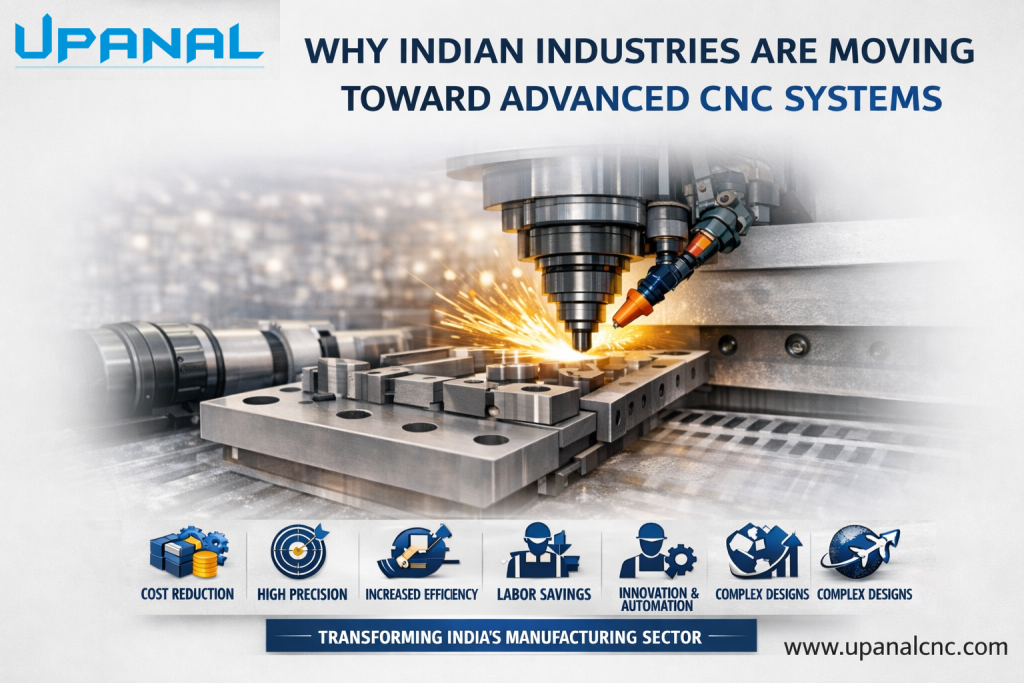
India’s manufacturing sector is undergoing a major transformation. With increasing global competition, rising labor costs, and demand for higher precision, industries across the country are shifting toward advanced CNC (Computer Numerical Control) systems.
From automotive to aerospace, heavy engineering to metal fabrication — CNC technology is becoming the backbone of modern production.
At Upanal CNC , we are witnessing this transition firsthand as more manufacturers invest in smarter, faster, and more reliable machining solutions.
The Changing Face of Indian Manufacturing
Indian industries are no longer competing only locally. Today, manufacturers supply components to global OEMs who demand:
- Tight tolerances
- Faster delivery cycles
- Consistent quality
- International manufacturing standards
Traditional machining methods struggle to meet these expectations. Advanced CNC systems bridge this gap by offering speed, repeatability, and accuracy at scale.
1. Higher Precision & Consistency
One of the biggest reasons for adopting advanced CNC systems is precision.
Modern CNC machines can achieve micron-level accuracy, ensuring every part produced matches exact specifications. Unlike manual machining, CNC systems eliminate human error and deliver consistent results across large production batches.
For industries like automotive, defense, and aerospace, this level of precision is mandatory — not optional.
At Upanal CNC, we focus on delivering advanced metal cutting solutions that help industries achieve consistent and repeatable precision.
2. Increased Production Speed
Time is money in manufacturing.
Advanced CNC systems operate continuously with minimal downtime. Automated tool changes, high-speed spindles, and optimized software programs significantly reduce production cycles.
This allows manufacturers to:
- Meet tight deadlines
- Handle bulk orders efficiently
- Improve overall plant productivity
With the right CNC partner, businesses can dramatically improve throughput and operational performance.
3. Reduced Labor Dependency
India is experiencing shifts in workforce availability and rising labor costs. Skilled machinists are in high demand, and manual dependency can limit scalability.
Advanced CNC systems reduce the need for constant manual intervention. With proper programming, one operator can manage multiple machines, improving operational efficiency while lowering long-term labor costs.
Upanal CNC supports industries with solutions that balance automation and performance for sustainable growth.
4. Complex Design Capabilities
Modern industries require complex geometries and customized components. Traditional machining methods often struggle with intricate shapes.
Advanced CNC systems can:
- Execute multi-axis operations
- Produce detailed contours
- Manufacture complex 3D components
This flexibility enables Indian manufacturers to serve high-value sectors and expand into new markets.
5. Integration with Industry 4.0
Smart factories are no longer a future concept — they are a present reality.
Advanced CNC systems integrate with:
- IoT sensors
- Real-time monitoring systems
- Production analytics software
- Predictive maintenance tools
At Upanal CNC , we understand the importance of future-ready manufacturing and support industries transitioning toward smarter production environments.
6. Improved Cost Efficiency & ROI
While advanced CNC systems require an initial investment, the long-term benefits outweigh the cost.
Manufacturers experience:
- Reduced material wastage
- Fewer rejected parts
- Lower rework rates
- Higher production output
The result? Faster return on investment and improved profit margins.
Conclusion
The shift toward advanced CNC systems in India is not just a technological trend — it is a strategic move toward smarter, faster, and more competitive manufacturing.
Industries that invest in advanced CNC technology today are building the foundation for tomorrow’s growth.
At Upanal CNC – Metal Cutting & Forming, we are committed to delivering complete metal cutting and forming solutions under one roof, empowering industries across South India with advanced technology and reliable support.
As manufacturing continues to evolve, the question is no longer whether to upgrade — but how soon.