
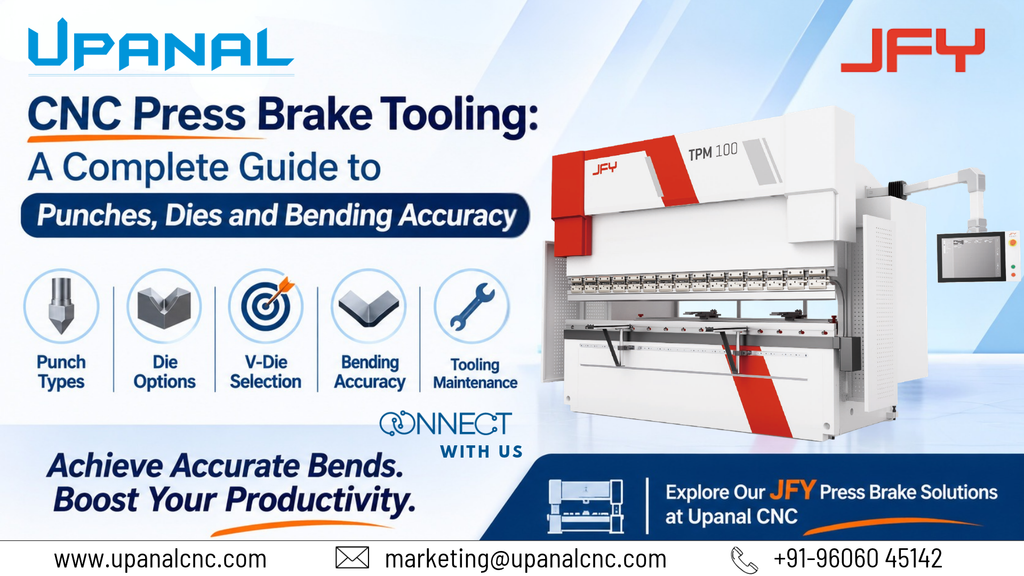
CNC Press Brake Tooling: A Complete Guide to Punches, Dies and Bending Accuracy
Introduction
In modern sheet metal manufacturing, achieving accurate and consistent bending is essential for producing high-quality components. A CNC Press Brake plays an important role in this process, but the machine alone does not determine bending quality. The selection of the right tooling, including punches and dies, is equally important.
CNC press brake tooling directly affects bending accuracy, production efficiency, surface finish and overall product quality. Choosing suitable tooling helps manufacturers reduce material wastage, minimize setup time and achieve consistent results.
In this guide, we will explore different types of CNC press brake tooling, their applications and how to select the right tools for your manufacturing requirements.
1. What Is CNC Press Brake Tooling?
CNC press brake tooling refers to the punches and dies installed in a press brake machine to bend sheet metal into the required shape and angle.
The punch is the upper tool that applies force to the material, while the die is the lower tool that supports the sheet and determines the bending shape.
The combination of the punch, die opening, material thickness and bending parameters determines the final bending result.
2. Types of CNC Press Brake Punches
Punches are available in different shapes and configurations depending on the bending application.
Straight Punch
Straight punches are commonly used for general-purpose bending operations. They are suitable for producing standard bends in sheet metal components.
Gooseneck Punch
Gooseneck punches feature a curved design that provides additional clearance for previously bent flanges. They are particularly useful when manufacturing complex sheet metal profiles.
Acute Angle Punch
Acute angle punches are designed for applications requiring bending angles smaller than 90 degrees.
Radius Punch
Radius punches are used when components require rounded bends instead of sharp edges. They help achieve smooth bending profiles.
3. Types of CNC Press Brake Dies
The die is the lower tooling component that supports the sheet metal during bending.
V-Die
V-dies are the most commonly used press brake dies. They are available in different opening sizes to accommodate various material thicknesses and bending requirements.
U-Die
U-dies are used for specific bending applications where a U-shaped profile is required.
Radius Die
Radius dies help produce rounded bending profiles and reduce sharp edges in finished components.
Multi-V Die
Multi-V dies provide multiple V-opening options in a single tool, offering flexibility for different bending operations.
4. Understanding V-Die Opening Selection
Selecting the correct V-die opening is one of the most important factors in achieving accurate bending results.
For air bending, a commonly used starting guideline is to select a V-opening approximately 6–8 times the material thickness for mild steel.
For example:
- 1 mm sheet: 6–8 mm V-opening
- 2 mm sheet: 12–16 mm V-opening
- 3 mm sheet: 18–24 mm V-opening
- 4 mm sheet: 24–32 mm V-opening
These are general guidelines, not fixed values. The ideal opening depends on material type, tensile strength, required inside radius, bending length and machine capacity.
5. How to Select the Right CNC Press Brake Tooling
Before selecting press brake tooling, manufacturers should consider the following factors:
1. Material Thickness
Tooling must be suitable for the thickness of the sheet metal being processed.
2. Material Type
Mild steel, stainless steel and aluminium have different bending characteristics. Tooling selection should account for material strength and springback.
3. Bending Angle
The required bending angle determines the punch geometry and die configuration.
4. Component Design
Complex profiles may require gooseneck punches or specialized tooling to avoid interference with previously bent sections.
5. Machine Tonnage
The tooling must be capable of handling the required bending force without exceeding its rated load capacity.
6. Tooling Compatibility
Ensure that the punch and die are compatible with the press brake’s tooling clamping system and machine specifications.
6. Common Press Brake Tooling Problems and Their Solutions
Incorrect Bending Angle: May result from incorrect tooling selection, material variation or improper machine settings. Verify the V-die opening and CNC bending parameters.
Uneven Bending: Can occur due to improper tool alignment, uneven loading or tooling wear. Check alignment and inspect the tooling condition.
Surface Marks on Sheet Metal: Damaged or contaminated tooling can leave unwanted marks. Use suitable tooling and protective films or inserts where appropriate.
Tool Wear and Damage: Excessive bending force and incorrect tool selection can damage tooling. Always follow the manufacturer’s tonnage and loading recommendations.
7. Importance of CNC Press Brake Tooling Maintenance
Regular tooling maintenance helps improve bending accuracy and extend tool life.
Recommended practices include:
- Clean punches and dies after use.
- Inspect tools regularly for cracks and deformation.
- Check punch and die alignment before production.
- Store tooling in a clean and organized environment.
- Avoid exceeding the recommended tooling load capacity.
- Replace damaged or worn tooling when required.
8. How CNC Press Brake Technology Improves Bending Productivity
Modern CNC press brake machines combine advanced control systems, accurate back gauges and suitable tooling to improve production efficiency.
Features such as programmable bending sequences, automatic angle compensation and advanced CNC controls help operators achieve repeatable results while reducing manual adjustments.
When the correct tooling is combined with a modern CNC press brake, manufacturers can improve productivity, reduce rejection rates and maintain consistent product quality.
9. Choosing the Right CNC Press Brake for Your Business
Selecting a CNC press brake involves more than considering machine tonnage and price. Manufacturers should evaluate:
- Maximum bending length
- Required bending capacity
- CNC control capabilities
- Tooling compatibility
- Back gauge configuration
- Production volume
- Technical support and after-sales service
Working with an experienced machine supplier can help identify the right machine and tooling combination for your applications.
Conclusion
CNC press brake tooling plays a critical role in achieving accurate, consistent and efficient sheet metal bending. Understanding different punch and die configurations, selecting the correct V-die opening and maintaining tooling regularly can significantly improve manufacturing performance.
At Upanal CNC, we provide advanced metal forming solutions through our JFY CNC Press Brake range, helping manufacturers improve bending accuracy, productivity and production efficiency.
Looking for the right CNC Press Brake solution for your manufacturing requirements?
Contact Upanal CNC today to explore our JFY Press Brake solutions and find the right machine for your business.