
CNC Turning vs CNC Milling: Understanding the Difference
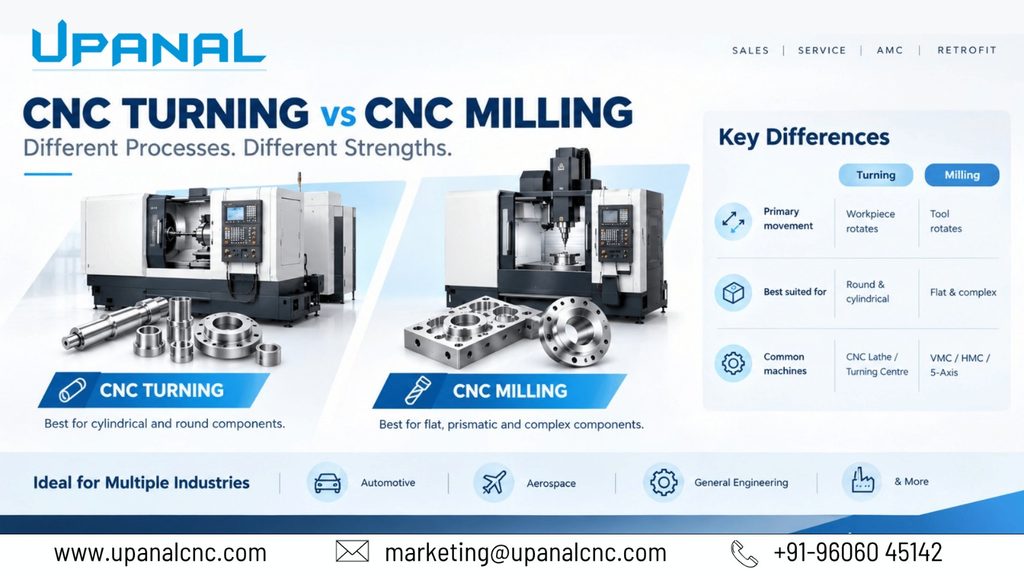
In modern manufacturing, precision, consistency, and productivity are essential for producing high-quality components. CNC machining has become a key technology for industries that require accurate and repeatable manufacturing.
Among the most widely used CNC processes are CNC turning and CNC milling. Although both use computer-controlled machines and cutting tools, they work differently and are suited to different types of components.
Understanding the difference between CNC turning and CNC milling can help manufacturers select the right machining process for their production requirements.
What is CNC Turning?
CNC turning is a machining process primarily used to manufacture cylindrical, round, or rotational components.
In CNC turning, the workpiece rotates at a controlled speed while a cutting tool moves along the workpiece to remove material. The machining process is controlled by a CNC program, allowing manufacturers to achieve consistent dimensions and repeatable results.
Common CNC Turning Applications
CNC turning is commonly used to manufacture:
- Shafts
- Bushes
- Pins
- Rollers
- Flanges
- Sleeves
- Threaded components
- Automotive components
- Hydraulic and pneumatic components
Modern CNC turning centres can also perform operations such as facing, threading, grooving, drilling, boring, and parting, depending on the machine configuration.
What is CNC Milling?
CNC milling is a machining process in which a cutting tool rotates while the workpiece is positioned and moved according to the programmed machining path.
CNC milling is highly suitable for producing components with flat surfaces, slots, pockets, holes, contours, and complex geometries.
Depending on the machine configuration, milling can be performed across multiple axes, allowing manufacturers to produce increasingly complex components with high accuracy.
Common CNC Milling Applications
CNC milling is commonly used for:
- Machine components
- Dies and moulds
- Fixtures
- Jigs
- Engine components
- Aerospace components
- Automotive parts
- Precision engineering components
- Complex 3D components
CNC Turning vs CNC Milling: Key Differences
| Feature | CNC Turning | CNC Milling |
| Primary movement | Workpiece rotates | Cutting tool rotates |
| Best suited for | Round and cylindrical components | Flat, prismatic and complex components |
| Typical operations | Facing, turning, threading, boring | Pocketing, slotting, contouring, drilling |
| Workpiece shape | Mainly rotational | Various shapes |
| Tool movement | Tool moves against rotating workpiece | Tool moves across the workpiece |
| Common machines | CNC Lathe / Turning Centre | VMC / HMC / 5-Axis Machining Centre |
Which Process Should You Choose?
The choice between CNC turning and CNC milling depends mainly on the shape, complexity, material, accuracy, and production requirements of the component.
Choose CNC Turning When:
- The component is primarily cylindrical.
- The part requires turning or threading.
- The majority of material removal is from a rotational surface.
- High productivity for round components is required.
Choose CNC Milling When:
- The component has flat surfaces or pockets.
- Complex profiles or contours are required.
- Multiple features need to be machined.
- The component requires multi-axis machining.
Can Turning and Milling Be Combined?
Yes. Modern manufacturing also uses turn-mill machining centres that combine turning and milling operations in a single machine.
This approach can reduce the number of setups and improve dimensional consistency between different features. It can be particularly useful for complex components that require both rotational and milling operations.
Factors to Consider When Selecting a CNC Machine
Before selecting a CNC machine, manufacturers should evaluate:
1. Component Geometry
Understand whether the component is primarily rotational, prismatic, or complex.
2. Material
The material being machined affects spindle power, tooling, cutting parameters, and machine rigidity.
3. Required Accuracy
Precision components may require machines with high rigidity, accurate positioning, and reliable thermal stability.
4. Production Volume
For high-volume production, cycle time, automation, tooling, and machine productivity become important factors.
5. Number of Operations
If multiple operations are required, selecting a machine capable of completing more operations in fewer setups can improve productivity.
Final Thoughts
CNC turning and CNC milling are both essential machining processes, but they serve different manufacturing requirements.
CNC turning is generally ideal for rotational components, while CNC milling is better suited for flat, prismatic, and complex components. Choosing the right process can improve machining accuracy, productivity, tool life, and overall production efficiency.
At Upanal CNC Solutions, we provide CNC machining solutions for a wide range of manufacturing requirements, including turning, milling, VMC, HMC, VTL, 5-axis machining, and other precision machining applications.
Looking for the Right CNC Machining Solution?
Talk to the Upanal CNC team to understand the right machine configuration for your component, production volume, and machining requirements.
Upanal CNC Solutions
One Partner. Total Metal Solutions.