
How 4th Axis and 5th Axis Machining Improve Production Efficiency
Modern manufacturing is moving toward higher precision, shorter production cycles, and increasingly complex components. As manufacturers look for ways to improve productivity while maintaining consistent quality, advanced CNC machining technologies are becoming increasingly important.
Traditional 3-axis CNC machines remain highly capable for many applications. However, when components require machining on multiple sides or involve complex geometries, additional rotary axes can provide significant advantages.
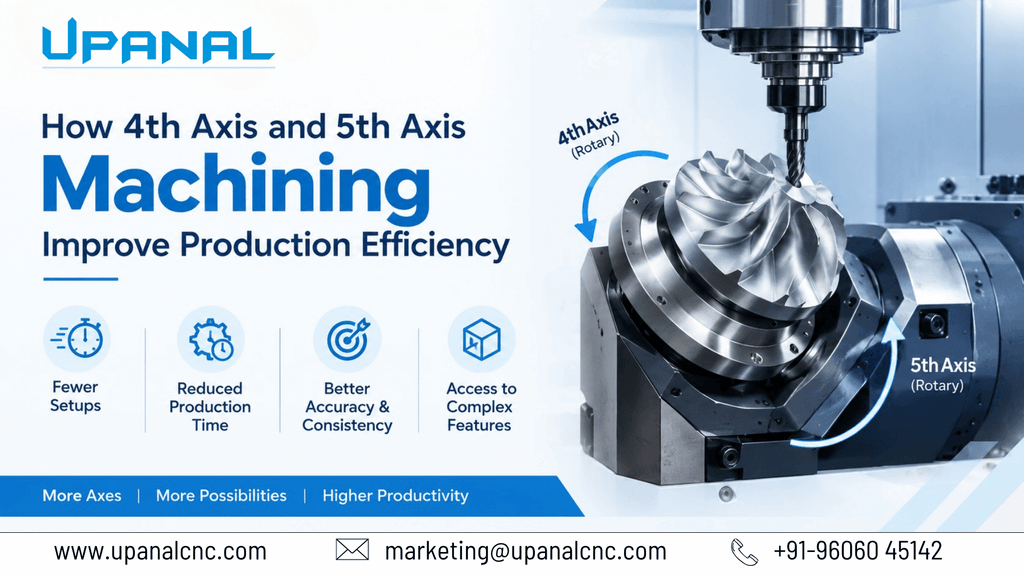
4th axis and 5th axis machining allow manufacturers to access more surfaces of a component with fewer setups, helping reduce production time, improve accuracy, and simplify complex machining operations.
What Is 4th Axis Machining?
A conventional 3-axis CNC machine generally moves along the X, Y, and Z axes.
A 4th axis adds a rotary axis, typically rotating the component around one of the linear axes. This allows the workpiece to be positioned at different angles without manually removing and repositioning it.
This capability is particularly useful when machining components that require features on multiple sides.
Key benefits of 4th axis machining include:
- Machining multiple sides of a component
- Fewer manual setups
- Reduced workpiece repositioning
- Improved positional consistency
- Better production efficiency
- Reduced operator intervention
For manufacturers producing components with repeated features around a central axis, a 4th axis can significantly simplify the machining process.
What Is 5th Axis Machining?
5-axis machining adds another rotary axis to the conventional 3-axis configuration.
Depending on the machine configuration, the additional axes allow the cutting tool and workpiece to move relative to each other in multiple directions. This provides greater flexibility when machining complex shapes, angled surfaces, deep cavities, and difficult-to-reach features.
5-axis machining is widely used for components where maintaining accuracy across multiple surfaces is important.
Typical applications include:
- Aerospace components
- Die and mould components
- Automotive parts
- Defence components
- Medical components
- Complex precision-engineered parts
How 4th and 5th Axis Machining Improve Production Efficiency
1. Fewer Setups
One of the biggest advantages of additional machining axes is the ability to complete more operations in a single setup.
With conventional machining, a component may need to be removed, repositioned, aligned, and clamped again to machine another surface.
Every additional setup takes time and introduces the possibility of alignment errors.
4th and 5th axis machining can reduce the number of setups required, allowing manufacturers to move from setup-intensive production toward a more streamlined machining process.
2. Reduced Production Time
Fewer setups can directly contribute to shorter production cycles.
Instead of stopping production to reposition the component manually, the CNC machine can access different surfaces through programmed rotary movement.
This can reduce:
- Setup time
- Handling time
- Re-alignment time
- Tool approach time
- Operator intervention
For repetitive production, even small reductions in cycle and setup time can make a meaningful difference to overall productivity.
3. Improved Accuracy and Consistency
Every time a workpiece is removed and reinstalled, there is a possibility of introducing positional variation.
4th and 5th axis machining can allow more operations to be completed without removing the component from the machine.
This helps maintain a consistent relationship between different features and can improve the overall accuracy of the finished component.
For precision manufacturing, reducing unnecessary setups can therefore be an important part of maintaining process consistency.
4. Better Access to Complex Features
Some components contain angled surfaces, curved profiles, deep pockets, or features that are difficult to reach using a conventional 3-axis machine.
Additional axes allow the cutting tool to approach these features from different orientations.
This can make it possible to machine geometries that would otherwise require multiple fixtures, special tooling, or additional operations.
5. Reduced Workholding Requirements
Complex components may require multiple fixtures when produced using conventional machining methods.
With 4th and 5th axis machining, a single workholding arrangement can sometimes provide access to several surfaces.
This can reduce fixture changes and simplify the overall production process.
It can also help manufacturers reduce the time and resources required for workholding preparation.
6. Improved Surface Finish
5-axis machining allows the cutting tool to maintain a more suitable orientation relative to the workpiece.
This can help optimize cutting conditions when machining curved or inclined surfaces.
Better tool orientation can contribute to improved surface finish and more consistent machining results, particularly on complex 3D components.
7. Reduced Operator Intervention
Automation is an important part of modern manufacturing.
When multiple operations can be completed in one setup, operators may spend less time manually repositioning components between operations.
This allows operators to focus more on machine monitoring, quality checks, tool management, and other production activities.
4th Axis vs 5th Axis Machining
While both technologies provide additional flexibility, they are suited to different production requirements.
| Feature | 4th Axis | 5th Axis |
| Additional movement | One rotary axis | Two rotary axes |
| Typical application | Multi-side and rotary machining | Complex multi-surface machining |
| Setup reduction | High | Very high for suitable components |
| Component complexity | Moderate to complex | Complex to highly complex |
| Programming requirements | Moderate | More advanced |
| Typical industries | Automotive, general engineering, production machining | Aerospace, defence, die & mould, precision engineering |
The right choice depends on the component geometry, production volume, accuracy requirements, cycle time, and overall manufacturing process.
4th Axis Applications
4th axis machining can be particularly useful for components that require machining around a central axis or on multiple sides.
Examples include:
- Shafts and cylindrical components
- Flanges
- Housings
- Components with multiple radial holes
- Parts requiring machining on several faces
- Repetitive production components
For manufacturers producing these types of components, adding a 4th axis can increase machine utilization while reducing manual handling.
5th Axis Applications
5-axis machining becomes particularly valuable when component geometry is complex and multiple surfaces need to be machined from different orientations.
Common applications include:
Aerospace
Aerospace components often feature complex geometries and strict precision requirements. 5-axis machining can provide better access to complex surfaces while reducing the number of setups.
Die & Mould
Moulds and dies frequently contain curved surfaces, deep cavities, and complex contours. 5-axis machining can improve tool access and support more efficient machining strategies.
Automotive
Complex automotive components can benefit from reduced setups and improved consistency, particularly when several features must be machined accurately in relation to one another.
Defence
Defence manufacturing often involves precision components with complex geometries and demanding machining requirements. Multi-axis machining can support these applications by providing greater flexibility.
General Precision Engineering
Manufacturers producing complex, high-value, or low-volume components can benefit from reducing setup time and improving machining flexibility.
Is 5-Axis Always Better Than 4-Axis?
Not necessarily.
The number of axes should be selected according to the manufacturing requirement rather than simply choosing the most advanced machine available.
A 4th axis may be sufficient for components that primarily require rotary positioning or machining on multiple sides.
A 5-axis machine can provide greater flexibility when components contain complex surfaces, angled features, or require simultaneous multi-axis machining.
The objective should be to select the machine configuration that provides the right balance between capability, productivity, accuracy, programming requirements, and investment.
What Should You Consider Before Choosing a 4th or 5th Axis Machine?
Before investing in an advanced CNC configuration, manufacturers should evaluate several factors:
Component Geometry
Study the number of surfaces, angles, curves, pockets, and complex features that need to be machined.
Production Volume
For high-volume production, reducing setup and cycle time can have a significant impact on productivity.
Required Accuracy
If multiple features need to maintain a precise relationship with one another, reducing the number of setups can be beneficial.
Cycle Time
Evaluate how much time can realistically be saved through additional axes and improved tool access.
CAM Capability
Advanced multi-axis machining requires appropriate CAM software, post-processors, and programming expertise.
Operator and Programming Skills
The benefits of advanced CNC equipment depend not only on the machine but also on the ability to program, operate, and maintain it effectively.
Overall Cost
Machine price is only one part of the investment. Manufacturers should also consider tooling, fixtures, CAM software, training, maintenance, and expected productivity improvements.
The Role of CAM in Multi-Axis Machining
The machine is only one part of a successful 4th or 5th axis machining process.
CAM software plays an important role in generating efficient toolpaths and controlling tool orientation.
A well-planned CAM strategy can help manufacturers:
- Optimize toolpaths
- Reduce unnecessary movements
- Improve tool access
- Maintain suitable cutting conditions
- Reduce machining time
- Improve surface quality
The combination of the right machine, tooling, CAM strategy, and skilled operators is essential to achieving the full benefits of multi-axis machining.
Moving Toward More Efficient CNC Manufacturing
As component designs become more complex and manufacturers face increasing pressure to improve productivity, 4th and 5th axis machining are becoming valuable tools for modern production.
The benefits go beyond simply adding more movement to a CNC machine. When applied to the right components, multi-axis machining can help manufacturers reduce setups, improve consistency, shorten production cycles, simplify workholding, and machine complex geometries more efficiently.
For manufacturers evaluating an upgrade to their CNC capabilities, the first step is to understand the specific requirements of their components and production process.
The right machining solution is not necessarily the machine with the highest number of axes—it is the solution that delivers the required precision, productivity, flexibility, and long-term value.
Conclusion
4th and 5th axis machining can transform the way complex components are manufactured.
By reducing setups, improving tool access, minimizing manual handling, and supporting complex geometries, these technologies can help manufacturers build a more efficient and consistent production process.
Whether you are producing aerospace components, automotive parts, dies and moulds, defence components, or precision-engineered products, understanding where 4th and 5th axis machining can add value is an important step toward modernizing your CNC manufacturing capabilities.
Looking to improve your CNC machining capabilities?
Upanal CNC Solutions provides advanced CNC machining solutions designed to meet the evolving requirements of modern manufacturing.
One Partner. Total Metal Solutions.