
How Machine Vibration Affects CNC Machining Quality
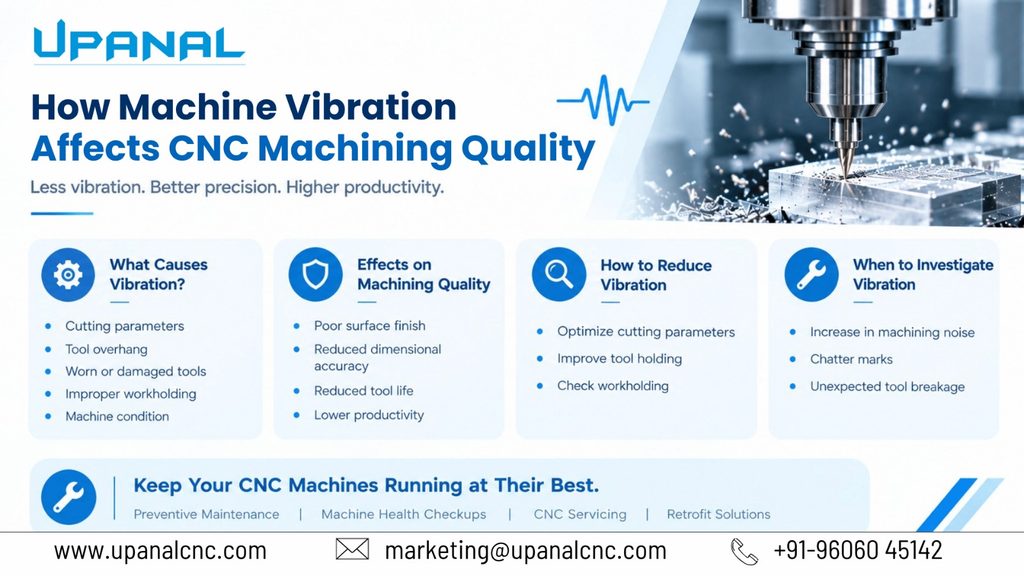
In CNC machining, precision is everything. Even a small amount of unwanted vibration can affect dimensional accuracy, surface finish, tool life, productivity, and ultimately the quality of the finished component.
Machine vibration—often referred to as chatter—is a common problem in CNC machining. It can occur during milling, turning, drilling, and other machining operations. Understanding its causes and effects can help manufacturers improve machining performance and reduce production problems.
What Is CNC Machine Vibration?
CNC machine vibration is an unwanted oscillation that occurs between the cutting tool, workpiece, spindle, and machine structure during machining.
Some vibration is normal during cutting, but excessive vibration can become a serious machining problem.
The most noticeable form is chatter, which produces a characteristic high-pitched sound and visible vibration during machining.
What Causes Vibration in CNC Machining?
Several factors can contribute to excessive vibration.
1. Improper Cutting Parameters
Incorrect spindle speed, feed rate, or depth of cut can create unstable cutting conditions.
Parameters that are too aggressive may increase cutting forces and cause vibration.
Optimizing:
- Spindle speed
- Feed rate
- Depth of cut
- Cutting speed
- Radial engagement
can help achieve more stable machining.
2. Tool Overhang
A cutting tool with excessive overhang behaves like a longer lever and becomes more susceptible to vibration.
Keeping tool overhang as short as practical can improve rigidity and machining stability.
3. Worn or Damaged Cutting Tools
A worn tool requires greater cutting force and may generate additional vibration.
Signs of tool-related vibration include:
- Poor surface finish
- Excessive tool wear
- Chatter marks
- Increased cutting noise
- Dimensional variation
Regular tool inspection and replacement can help prevent these issues.
4. Improper Workholding
The workpiece must be securely clamped.
Insufficient clamping force or poor workholding can allow the component to move or vibrate during machining.
This can lead to dimensional errors and poor surface quality.
5. Machine Condition
The machine itself can also be a source of vibration.
Potential causes include:
- Worn bearings
- Spindle problems
- Loose mechanical components
- Guideway wear
- Poor machine leveling
- Damaged couplings
- Backlash or mechanical play
Regular machine inspection can help identify these problems before they affect production.
How Does Vibration Affect Machining Quality?
1. Poor Surface Finish
One of the most visible effects of vibration is an inconsistent surface finish.
Chatter can leave repetitive marks on the component, making the surface rougher and reducing the overall quality of the finished part.
2. Reduced Dimensional Accuracy
Excessive vibration can cause the cutting tool to move away from its intended cutting path.
This can result in:
- Incorrect dimensions
- Poor tolerances
- Profile errors
- Inconsistent components
For precision manufacturing, even small deviations can become significant.
3. Reduced Tool Life
Continuous vibration places additional stress on cutting tools.
This can accelerate:
- Flank wear
- Edge chipping
- Tool breakage
- Thermal damage
Reducing vibration can therefore help manufacturers improve tool life and reduce tooling costs.
4. Damage to the Machine
Persistent vibration can also affect machine components.
Over time, excessive vibration may contribute to wear in:
- Spindle bearings
- Tool holders
- Ball screws
- Guideways
- Mechanical assemblies
This is why vibration should not simply be treated as a noise problem.
5. Lower Productivity
When vibration occurs, operators may need to reduce cutting parameters to protect the tool and improve surface finish.
While this may solve the immediate problem, it can also increase cycle time and reduce production efficiency.
How Can CNC Machine Vibration Be Reduced?
Manufacturers can take several steps to control vibration.
Optimize Cutting Parameters
Experiment with spindle speed, feed rate, and depth of cut to find a stable machining condition.
Improve Tool Holding
Use appropriate tool holders and minimize tool overhang wherever possible.
Check Workholding
Ensure that the component is properly supported and securely clamped.
Inspect the Spindle
Unusual spindle noise, vibration, or temperature can indicate a potential spindle problem.
A professional spindle inspection can help identify underlying issues.
Maintain the Machine
Regular preventive maintenance can help detect mechanical problems before they result in serious vibration.
Machine Health Checkups can include inspection of critical mechanical and operational parameters.
How Ball Bar Testing Can Help
For CNC machines where accuracy and motion performance are critical, Ball Bar Testing can be used to evaluate machine tool positioning performance.
The test can help identify potential issues related to:
- Backlash
- Positioning accuracy
- Servo performance
- Geometric errors
- Circular interpolation performance
This provides manufacturers with valuable information about the machine’s condition and helps determine whether further calibration or maintenance is required.
When Should You Investigate Machine Vibration?
Don’t ignore vibration when you notice:
- A sudden increase in machining noise
- Repeated chatter marks
- Unexpected tool breakage
- Changes in surface finish
- Dimensional inconsistencies
- Spindle vibration
- Increased tool wear
These symptoms may indicate that the problem is not simply related to cutting parameters.
Maintenance Can Prevent Bigger Problems
CNC machines operate under demanding conditions, and small mechanical or operational issues can gradually affect machining performance.
A structured maintenance program that includes Preventive Maintenance, Machine Health Checkups, accuracy testing, and professional CNC servicing can help manufacturers identify potential problems early.
For older machines, a CNC retrofit may also be worth considering when outdated control systems, drives, electrical components, or other systems are limiting machine performance.
Conclusion
Machine vibration is more than just an unwanted sound. It can directly affect surface finish, dimensional accuracy, tool life, machine reliability, and production efficiency.
By optimizing machining parameters, improving workholding, minimizing tool overhang, monitoring spindle condition, and maintaining the machine regularly, manufacturers can significantly reduce vibration-related problems.
For manufacturers aiming to achieve consistent precision and productivity, controlling vibration should be an essential part of CNC machine management.
Need help diagnosing CNC machine vibration or improving machine performance?
Upanal CNC Solutions provides CNC machine servicing, preventive maintenance, machine health checkups, accuracy testing, and retrofit solutions to help manufacturers keep their machines performing reliably.