
How to Estimate CNC Machining Cost Before Starting a Job
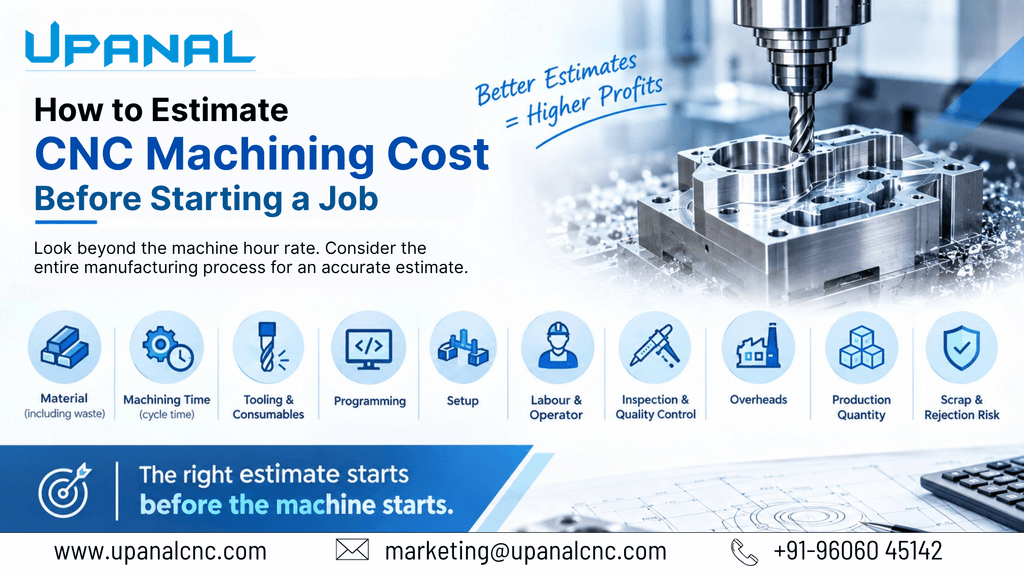
In CNC manufacturing, getting the machining cost right before starting a job is critical for both competitive quoting and profitable production.
A quotation that is too high may lose the customer. A quotation that is too low can reduce margins and create problems during production.
So, how do you estimate the cost of a CNC machining job accurately?
The answer is not simply the machine’s hourly rate. A reliable estimate should consider material, machining time, tooling, programming, setup, labour, inspection, finishing, overheads and production quantity.
1. Start With the Component Drawing
Before calculating the cost, study the component drawing carefully.
Look at:
- Material specification
- Overall dimensions
- Tolerances
- Surface finish requirements
- Number of operations
- Holes, pockets and contours
- Complex geometries
- Critical dimensions
- Special inspection requirements
A simple-looking component may require multiple setups or specialised tooling, which can significantly affect the final machining cost.
2. Calculate the Raw Material Cost
Material is one of the first costs to consider.
The calculation should include:
Raw Material Cost = Material Weight × Material Rate
However, don’t calculate only the finished component weight.
Consider the raw material size required for machining and the material that will become chips during the process.
For example, a component weighing 5 kg may require a 7 kg or 8 kg raw material block depending on its geometry and machining requirements.
Material utilisation therefore has a direct impact on job profitability.
3. Estimate CNC Machining Time
Machining time is one of the most important elements of the cost calculation.
Consider:
- Roughing time
- Finishing time
- Drilling
- Tapping
- Boring
- Pocketing
- Contouring
- Tool changes
- Rapid movements
- Workpiece loading and unloading
A basic calculation can be:
Machining Cost = Machine Hourly Rate × Machining Time
Accurate cycle-time estimation becomes especially important when quoting large quantities.
Even a small difference in cycle time can become significant when multiplied across hundreds or thousands of components.
4. Include Machine Setup Time
Setup time is often overlooked during quoting.
It can include:
- Fixture installation
- Workpiece alignment
- Tool setting
- Work offset setting
- Program loading
- First-piece setup
- Proving the program
- Trial machining
For a small batch, setup cost can represent a significant portion of the total job cost.
For larger batches, the same setup cost is distributed across more components.
Therefore:
Setup Cost per Part = Total Setup Cost ÷ Quantity
5. Consider Programming Cost
Complex components may require CAM programming before production begins.
Programming time depends on factors such as:
- Component complexity
- Number of operations
- Number of axes
- Toolpath complexity
- Surface machining
- Simulation and verification requirements
For simple components, programming may take relatively little time. Complex 3-axis, 4-axis or 5-axis components can require considerably more preparation.
6. Calculate Tooling and Consumable Costs
Tooling is another important part of CNC machining cost.
Depending on the component, you may need:
- End mills
- Drills
- Inserts
- Reamers
- Taps
- Boring tools
- Special cutters
- Tool holders
- Coolant
Tool cost should ideally be distributed across the number of components that can be produced before the tool needs replacement.
For example:
Tool Cost per Part = Total Tooling Cost ÷ Expected Tool Life in Parts
This provides a more realistic production cost.
7. Add Labour and Operator Cost
Although CNC machines automate much of the machining process, operators are still required for production activities.
Labour may include:
- Machine loading and unloading
- Tool changes
- Measurement
- Inspection
- Deburring
- Handling
- Setup assistance
The labour component should therefore be included when calculating the complete manufacturing cost.
8. Include Inspection and Quality Control
Some components require more inspection than others.
Depending on customer requirements, this may involve:
- Vernier measurement
- Micrometer measurement
- Height gauge inspection
- Bore measurement
- Surface finish inspection
- CMM inspection
- First-piece inspection
- Inspection reports
If the job requires detailed inspection documentation, the associated time and cost should be included in the quotation.
9. Consider Secondary Operations
CNC machining may not always be the final manufacturing process.
Additional operations can include:
- Deburring
- Grinding
- Heat treatment
- Surface treatment
- Plating
- Anodizing
- Painting
- Laser marking
- Welding
- Assembly
These costs should be included separately or clearly incorporated into the final part price.
10. Account for Machine Overheads
The machine hourly rate should reflect more than just electricity consumption.
Machine cost can include:
- Electricity
- Maintenance
- AMC/service
- Tooling support
- Depreciation
- Machine financing
- Factory infrastructure
- Operator cost
- Consumables
A realistic machine-hour rate helps ensure that the quotation covers the actual cost of operating the equipment.
11. Consider Production Quantity
Quantity can significantly change the cost per component.
For example, a job requiring one setup and one hour of programming may be expensive when producing only 5 components.
The same setup and programming cost can be distributed across 500 components.
This is why CNC machining quotations should always consider:
Total Job Cost = Fixed Costs + Variable Costs
Where:
Fixed Costs may include programming and setup.
Variable Costs may include material, machining time, tooling and finishing.
12. Don’t Forget Scrap and Rejection Risk
Production does not always go perfectly.
Factors such as:
- Material defects
- Tool failure
- Programming errors
- Dimensional rejection
- Setup errors
- Unexpected machine downtime
can increase the actual production cost.
For critical jobs, manufacturers may need to consider a reasonable allowance for process risk and rejection.
A Simple CNC Machining Cost Formula
A basic estimation model can be:
Total Machining Cost =
Material + Programming + Setup + Machining + Tooling + Labour + Inspection + Secondary Operations + Overheads
Then:
Cost Per Part = Total Job Cost ÷ Production Quantity
Finally, the required profit margin can be added to arrive at the selling price.
Example
Consider a hypothetical CNC milling job requiring 100 components.
Assume:
- Material cost: ₹800 per component
- Programming: ₹5,000
- Setup: ₹3,000
- Machining: ₹600 per component
- Tooling: ₹100 per component
- Inspection: ₹50 per component
- Other operations: ₹100 per component
The total production-related cost should be calculated by separating the fixed costs from the per-piece costs.
This approach provides a much clearer picture than simply multiplying machining time by an hourly machine rate.
Why Accurate Cost Estimation Matters
A proper CNC cost estimate helps manufacturers:
- Prepare competitive quotations
- Protect profit margins
- Compare different machining strategies
- Identify expensive operations
- Improve production planning
- Reduce unexpected costs
- Make better machine utilisation decisions
Most importantly, it allows manufacturers to make decisions based on the complete manufacturing process rather than machine price alone.
Final Thoughts
Estimating CNC machining cost before starting a job requires more than calculating machine time.
The most reliable approach is to evaluate the entire manufacturing cycle — from raw material and programming to machining, tooling, inspection and finishing.
When these factors are considered systematically, manufacturers can create more accurate quotations, reduce cost overruns and improve overall production profitability.
For manufacturers handling complex components or varying production volumes, selecting the right CNC machine, tooling, workholding and machining strategy can make a significant difference to the final cost per component.
The right estimate starts before the machine starts.