
How to Plan CNC Machine Capacity for Growing Manufacturing Businesses
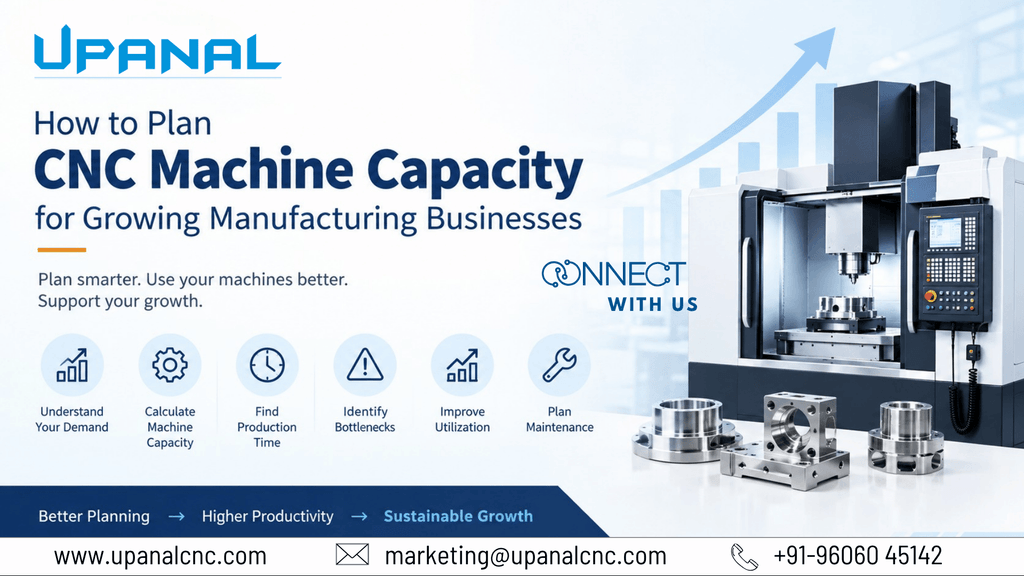
As manufacturing businesses grow, managing production capacity becomes increasingly important. Increasing customer orders, shorter delivery timelines, and higher quality expectations can put pressure on existing CNC machines and production teams. Without proper capacity planning, manufacturers may experience production delays, machine bottlenecks, increased overtime, and higher operating costs.
Effective CNC machine capacity planning helps businesses understand their current production capabilities, identify capacity gaps, and make informed decisions about machine utilization, additional equipment, and future expansion.
In this blog, we explore how manufacturers can plan CNC machine capacity efficiently to support business growth and improve overall production performance.
What Is CNC Machine Capacity Planning?
CNC machine capacity planning is the process of determining how much production a machine or manufacturing facility can handle within a specific period.
It involves evaluating machine availability, cycle times, setup requirements, operator availability, maintenance schedules, and production demand.
For example, a manufacturing unit operating multiple CNC machining centers must determine whether its existing machines can meet increasing demand without compromising product quality or delivery schedules.
Proper capacity planning helps manufacturers balance production requirements with available resources while avoiding unnecessary investments.
1. Understand Your Current Production Demand
The first step in capacity planning is understanding how much production your business needs to deliver.
Review customer orders, monthly production targets, forecasted demand, and seasonal variations. Identify which components require the most machining time and which orders have strict delivery deadlines.
Consider the following factors:
- Number of components required per month
- Average machining time per component
- Number of production shifts
- Order frequency and batch sizes
- Expected growth in customer demand
- Special machining or fabrication requirements
Accurate demand forecasting provides a foundation for determining whether your existing CNC machines can support future requirements.
2. Calculate Available Machine Capacity
Available machine capacity represents the time a machine can realistically operate during a given period.
For example, suppose a CNC machine operates for 8 hours per day over 25 working days.
Monthly scheduled capacity:
8 hours × 25 working days = 200 hours per month.
However, the machine may not be available for production during the entire 200 hours. Tool changes, setup operations, preventive maintenance, breakdowns, and other interruptions can reduce the actual time available for machining.
Manufacturers should distinguish between scheduled capacity and productive machining time to develop realistic production plans.
3. Calculate the Production Time Required
Once the available capacity is understood, calculate how much machine time is required to meet production demand.
A basic formula is:
Required machining hours = Quantity required × Cycle time per component ÷ 60
For example, if a component requires 12 minutes of machining time and monthly demand is 600 components:
600 × 12 minutes = 7,200 minutes, or 120 machining hours.
If setup and changeover operations require an additional 15 hours, the total requirement becomes 135 hours.
This calculation helps determine whether the machine has sufficient capacity to meet the production target.
For more accurate planning, include loading and unloading, inspection, tool changes, and other machine-specific activities where relevant.
4. Identify Production Bottlenecks
A production bottleneck occurs when one machine or process limits the output of the entire manufacturing operation.
For example, a factory may have sufficient milling capacity but limited turning capacity. Components may accumulate while waiting for turning operations, delaying subsequent processes and final dispatch.
To identify bottlenecks:
- Compare the workload assigned to each machine.
- Review waiting time between production stages.
- Identify machines with consistently high utilization.
- Examine recurring delays and missed delivery commitments.
- Check whether certain jobs require specialized machine capabilities.
Depending on the situation, solutions may include improving production scheduling, balancing workloads, reducing setup times, or investing in additional machine capacity.
5. Improve CNC Machine Utilization
Before purchasing additional equipment, manufacturers should evaluate whether existing machines are being used efficiently.
Several improvements can help increase productive capacity.
Optimize setup time: Standardize workholding, tooling arrangements, and setup procedures to reduce changeover delays.
Improve production scheduling: Group compatible jobs where practical to reduce frequent tool and fixture changes.
Use suitable tooling: Select appropriate cutting tools and machining parameters for the material and component requirements.
Reduce unplanned downtime: Follow preventive maintenance schedules and address recurring machine problems.
Improve operator skills: Train operators in machine operation, setup procedures, tool management, and basic troubleshooting.
These improvements can help businesses increase output from existing equipment without immediately expanding their machine fleet.
6. Plan for Preventive Maintenance
Capacity planning should include machine maintenance rather than treating it as an unexpected interruption.
Preventive maintenance helps manufacturers schedule inspections, lubrication, component checks, and other maintenance activities around production requirements.
Without planned maintenance, unexpected breakdowns can reduce available machine hours and disrupt delivery schedules.
A structured maintenance approach, supported by an Annual Maintenance Contract (AMC) where appropriate, can help businesses improve machine reliability, manage maintenance costs, and plan production more consistently.
7. Determine When to Invest in Additional Machines
Purchasing additional machinery may become necessary when production demand consistently exceeds available capacity.
However, the decision should be based on more than the number of incoming orders.
Evaluate the following factors:
- Current machine utilization and workload
- Projected customer demand
- Complexity and variety of components
- Required machining accuracy and productivity
- Availability of skilled operators
- Floor space, tooling, fixtures, and supporting infrastructure
- Investment costs and expected return
Depending on the application, manufacturers may consider a Vertical Machining Center (VMC), Horizontal Machining Center (HMC), CNC turning center, drill-tap center, vertical turning lathe, fiber laser cutting machine, CNC press brake, or turret punching machine.
The right choice depends on the manufacturing process, material, component dimensions, production volume, and required accuracy.
Selecting suitable equipment helps address existing production constraints while supporting future business growth.
8. Plan Capacity Across Metal Cutting and Metal Forming Operations
For manufacturers working with sheet metal, fabrication, precision components, or industrial equipment, capacity planning must cover more than one machine or process.
Metal cutting and metal forming operations often work together to complete a product. If laser cutting output increases but bending capacity remains limited, work-in-progress can accumulate between the two processes.
Manufacturers should therefore evaluate the capacity of each major production stage.
Metal cutting operations may include:
- CNC milling and turning
- Vertical and horizontal machining
- Fiber laser cutting
- Turret punching
- Drilling and tapping
Metal forming operations may include:
- CNC press brake bending
- Sheet metal forming
- Busbar punching and processing
- Other application-specific forming processes
Balancing capacity across these operations helps reduce production bottlenecks, improve workflow, and support more consistent delivery schedules.
9. Use Flexible Capacity Planning for Future Growth
Manufacturing demand can change quickly. Capacity plans should therefore be reviewed regularly rather than prepared only when production problems arise.
Businesses can prepare for growth by:
- Forecasting production requirements for the next 6–12 months.
- Monitoring machine utilization and downtime.
- Comparing production targets with actual output.
- Evaluating opportunities for additional shifts.
- Developing a skilled workforce.
- Planning machine purchases according to demand forecasts.
- Reviewing capacity across all critical production processes.
A flexible capacity plan helps manufacturers respond to new orders while avoiding unnecessary capital expenditure.
Example: CNC Machine Capacity Planning
Consider a manufacturing unit that needs to produce 1,000 components per month on a CNC machining center.
Assume the following:
- Scheduled monthly machine time: 200 hours
- Machining cycle time: 10 minutes per component
- Setup and changeover time: 20 hours per month
The required machining time is:
1,000 × 10 minutes = 10,000 minutes, or approximately 166.7 hours.
Including setup time, the total requirement is approximately 186.7 hours.
This leaves only 13.3 hours of the scheduled 200 hours for other interruptions. If maintenance, breakdowns, or additional changeovers consume that remaining time, the production target may not be achievable consistently.
The manufacturer should evaluate actual downtime, available shifts, setup improvements, and future demand before deciding whether additional capacity is required.
This example demonstrates why planning based only on theoretical machine hours can lead to unrealistic production targets.
How UPANAL CNC Solutions Supports Your Manufacturing Growth
UPANAL CNC Solutions – One Partner. Total Metal Solutions.
UPANAL CNC Solutions is your one-stop solution for metal cutting and metal forming machines, helping manufacturers identify suitable technologies for their production requirements and future expansion plans.
Our comprehensive range of solutions supports different manufacturing applications, from precision component machining to sheet metal fabrication.
Metal Cutting Solutions
Our metal cutting portfolio includes CNC machining centers, vertical and horizontal machining centers, CNC turning solutions, vertical turning lathes, drill-tap centers, double column machining centers, and fiber laser cutting machines.
These solutions help manufacturers address requirements related to precision machining, productivity, component complexity, and production capacity.
Metal Forming Solutions
Our metal forming portfolio includes JFY fiber laser cutting machines, CNC press brakes, turret punching machines, and busbar processing solutions for suitable industrial applications.
These technologies help manufacturers improve sheet metal processing, bending accuracy, fabrication productivity, and production consistency.
Service and Maintenance Support
Beyond machine supply, UPANAL provides CNC machine servicing, preventive maintenance, Annual Maintenance Contracts (AMC), and technical support to help manufacturers maintain machine performance and minimize unplanned downtime.
By bringing machines, service, and technical expertise together, UPANAL helps businesses make informed equipment decisions and plan their manufacturing capacity more effectively.
Whether you are establishing a new manufacturing unit, expanding an existing facility, or upgrading production capabilities, UPANAL CNC Solutions can help you explore solutions suited to your operational requirements.
Conclusion
Effective CNC machine capacity planning enables manufacturing businesses to balance production demand, machine availability, workforce capability, and investment decisions.
By understanding production requirements, calculating realistic machine capacity, identifying bottlenecks, improving utilization, and planning for future demand, manufacturers can improve productivity and meet customer commitments more reliably.
Choosing the right equipment is equally important. A well-planned combination of metal cutting and metal forming technologies can help manufacturers create a more efficient, flexible, and scalable production environment.
Looking to expand your manufacturing capacity?
Contact UPANAL CNC Solutions to explore the right metal cutting and metal forming machines for your business.
UPANAL CNC Solutions – One Partner. Total Metal Solutions.