
Laser Cutting for Electrical Panels, Enclosures and Industrial Cabinets
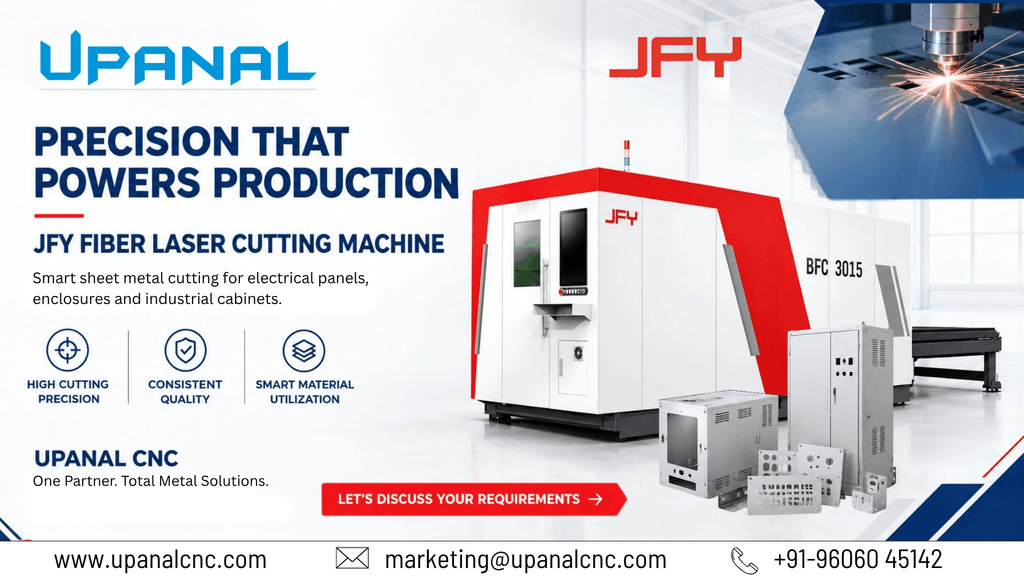
In modern manufacturing, precision, consistency, and productivity are essential for producing high-quality electrical panels, enclosures, and industrial cabinets. These components require accurate cutouts, clean edges, and precise dimensions to ensure proper fitting and reliable assembly.
Fiber laser cutting technology has become an effective solution for manufacturers looking to improve sheet metal processing, reduce material waste, and achieve consistent production quality.
At UPANAL CNC, we offer JFY Fiber Laser Cutting Machines to help manufacturers improve their sheet metal fabrication capabilities with advanced cutting technology.
Why Is Precision Important in Electrical Panel Manufacturing?
Electrical panels and industrial enclosures contain mounting plates, ventilation openings, cable entry points, switch cutouts, and other features that require accurate dimensions.
Even small cutting errors can create assembly difficulties, increase rework, and affect production efficiency.
Precision cutting helps manufacturers achieve:
- Accurate openings for switches, displays, and electrical components.
- Consistent dimensions across multiple panels.
- Clean edges with reduced finishing requirements.
- Better fitting and assembly of enclosure components.
- Improved repeatability for batch production.
How Does Fiber Laser Cutting Work?
Fiber laser cutting uses a concentrated laser beam to cut sheet metal according to a programmed design. The machine follows digital cutting paths generated from CAD/CAM software to produce the required shapes and openings.
Depending on the material, thickness, machine configuration, and cutting parameters, fiber laser technology can process materials such as mild steel, stainless steel, and aluminium.
For electrical panel manufacturers, this enables efficient production of mounting plates, enclosure doors, side panels, brackets, and other sheet metal components.
Key Benefits of Laser Cutting for Electrical Panels and Enclosures
1. High Cutting Precision
Laser cutting supports the production of complex profiles, small openings, and detailed cutouts. This is particularly useful when manufacturing panels with multiple component mounting points and cable entry openings.
2. Faster Production
Automated cutting paths and reduced manual intervention can help manufacturers process repeated designs more efficiently. Actual production speed depends on material thickness, laser power, part geometry, and cutting parameters.
3. Consistent Quality
Once the cutting program and parameters are properly established, the machine can reproduce the same design across multiple components, helping maintain consistency during batch production.
4. Reduced Material Waste
Efficient nesting software can arrange multiple parts on a sheet to improve material utilization. This helps reduce scrap and control raw material costs.
5. Flexibility for Different Designs
Manufacturers can adapt cutting programs to accommodate different enclosure sizes, mounting patterns, ventilation slots, and custom panel designs without requiring dedicated mechanical tooling for every profile.
6. Cleaner Cutting and Reduced Secondary Operations
With suitable material, parameters, and machine setup, fiber laser cutting can produce smooth edges and reduce the need for additional finishing operations. Results vary depending on the material and application.
JFY Fiber Laser Cutting Machine: A Smart Solution for Sheet Metal Fabrication
The JFY Fiber Laser Cutting Machine, available through UPANAL CNC, is a solution for manufacturers looking to improve precision, productivity, and flexibility in sheet metal processing.
JFY laser cutting technology supports the production of electrical panel components, industrial cabinets, distribution board enclosures, and custom sheet metal parts.
Key advantages include:
- Precision Cutting: Produce complex profiles, mounting holes, and component openings.
- Production Efficiency: Use automated cutting programs to streamline repetitive manufacturing operations.
- Design Flexibility: Accommodate different panel sizes and custom enclosure designs.
- Material Optimization: Improve sheet utilization through suitable nesting and cutting strategies.
- Versatile Applications: Process compatible sheet metals according to the machine configuration and material thickness.
By integrating a JFY fiber laser cutting machine into their fabrication workflow, manufacturers can improve process consistency and respond more efficiently to changing production requirements.
Applications of JFY Laser Cutting in Electrical Panel Manufacturing
JFY fiber laser cutting machines can support the production of a wide range of components, including:
- Electrical control panel doors and covers.
- Industrial automation cabinets.
- Distribution board enclosures.
- Mounting plates and component support panels.
- Cable entry plates and gland openings.
- Ventilation slots and sheet metal brackets.
- Machine safety guards and protective covers.
- Custom sheet metal housings and enclosures.
For manufacturers producing different enclosure sizes or frequent design variations, programmable laser cutting can provide greater flexibility in production planning.
Fiber Laser Cutting vs. Conventional Cutting Methods
Traditional processes such as mechanical punching, shearing, and drilling remain useful for many manufacturing applications. However, fiber laser cutting offers specific advantages for complex profiles and frequently changing designs.
- Complex Shapes: Laser cutting can produce intricate profiles without dedicated punching tools for each shape.
- Design Flexibility: New cutting programs can accommodate revised component designs.
- Reduced Tooling Dependency: Many profiles can be produced without application-specific cutting dies.
- Digital Production Planning: CAD/CAM programming and nesting software can support efficient material utilization.
The best process depends on production volume, material thickness, part geometry, required tolerances, and operating costs. For high-volume parts with repetitive features, turret punching may still be an economical choice.
Choosing the Right JFY Fiber Laser Cutting Machine
Before investing in a JFY fiber laser cutting machine for electrical panel and enclosure manufacturing, consider the following factors:
Laser Power: Select a suitable power rating based on your material types, thickness range, and required productivity.
Working Area: Ensure the cutting bed accommodates your standard sheet sizes and typical component dimensions.
Cutting Accuracy: Evaluate the machine’s positioning performance, repeatability, and suitability for your component tolerances.
Software and Nesting: Look for programming capabilities that simplify design changes and support efficient material usage.
Automation Requirements: Assess whether loading, unloading, and material handling automation would improve your production workflow.
Service and Technical Support: Consider installation, operator training, spare parts availability, and ongoing maintenance support.
Selecting the right machine according to your production requirements can help improve long-term manufacturing efficiency.
Complete Metal Cutting and Forming Solutions from UPANAL CNC
UPANAL CNC provides comprehensive metal cutting and metal forming solutions for modern manufacturing industries.
Our solutions include:
- JFY Fiber Laser Cutting Machines for precision sheet metal cutting.
- JFY Press Brakes for accurate sheet metal bending.
- JFY Turret Punching Machines for punching and forming sheet metal components.
- Busbar Processing Solutions for electrical manufacturing applications.
By combining the right cutting, bending, and punching technologies, manufacturers can build an efficient production workflow for electrical panels, industrial cabinets, and custom enclosures.
Whether you are expanding production capacity or upgrading your existing fabrication process, UPANAL CNC can help you explore suitable solutions for your manufacturing requirements.
Conclusion
Fiber laser cutting is an important technology for modern electrical panel, enclosure, and industrial cabinet manufacturing. It offers flexibility for complex designs, consistent cutting quality, and opportunities to improve material utilization and production efficiency.
With JFY Fiber Laser Cutting Machines from UPANAL CNC, manufacturers can explore advanced sheet metal cutting solutions suited to their application and production needs.
Looking for the right laser cutting solution for your electrical panel or enclosure manufacturing requirements?
Contact UPANAL CNC to discuss your application and explore the suitable JFY fiber laser cutting machine for your business.
UPANAL CNC — One Partner. Total Metal Solutions.
Frequently Asked Questions
1. Can a JFY fiber laser cutting machine be used for electrical panel manufacturing?
Yes. It can support the cutting of mounting plates, doors, covers, cable openings, brackets, and other compatible sheet metal components used in electrical panels.
2. Which materials can a JFY fiber laser cutting machine process?
Depending on the machine configuration and cutting parameters, compatible materials may include mild steel, stainless steel, and aluminium.
3. Does laser cutting eliminate all finishing operations?
No. Laser cutting can reduce secondary finishing in suitable applications, but the result depends on the material, thickness, cutting parameters, and required edge quality.
4. Is fiber laser cutting better than turret punching for electrical enclosures?
It depends on component design and production volume. Laser cutting offers flexibility for complex profiles and design changes, while turret punching can be cost-effective for high-volume parts with repeated features.
5. How do I choose the right JFY laser cutting machine?
Consider material thickness, sheet size, required cutting quality, production volume, laser power, software capabilities, automation needs, and available service support.