
Metal Fabrication Requirements in the Solar Energy Industry
Introduction
The solar energy industry is growing rapidly as businesses and governments increasingly adopt renewable energy solutions. From large-scale solar power plants to rooftop solar installations, every project requires strong, durable and precision-engineered metal components.
Metal fabrication plays an important role in solar energy infrastructure. Components such as solar panel mounting structures, support frames, brackets, electrical enclosures and structural assemblies require accurate cutting, bending, punching and machining.
With advanced CNC metal cutting and metal forming technologies, manufacturers can improve production efficiency, maintain consistent quality and meet the growing demands of the solar energy sector.
1. Key Metal Components Used in Solar Energy Systems
Solar installations require various fabricated metal components to ensure structural stability and long-term performance.
Some important components include:
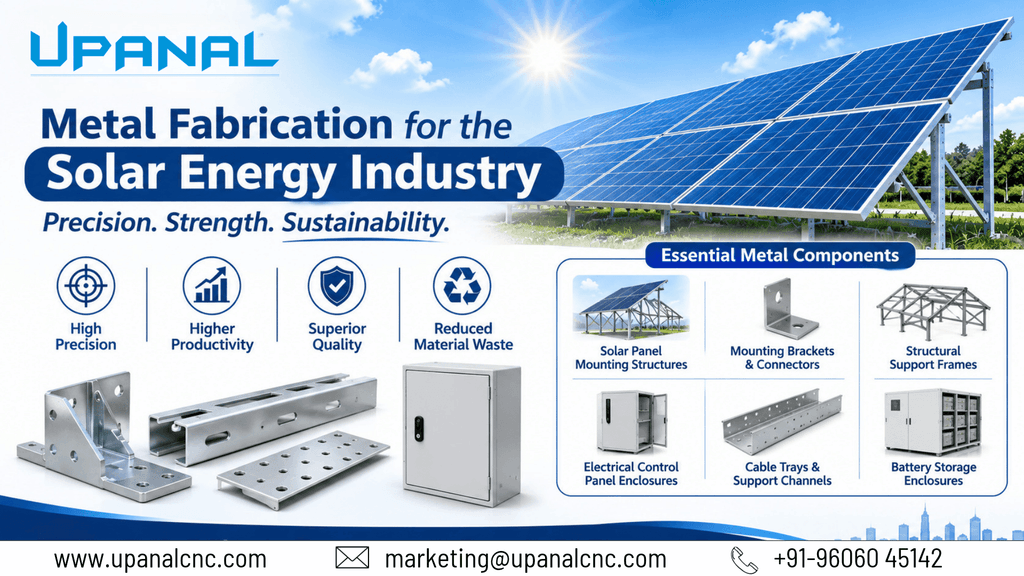
- Solar Panel Mounting Structures: Metal frames that support solar panels at the required angle and position.
- Mounting Brackets and Connectors: Components used to secure solar panels and connect structural assemblies.
- Structural Support Frames: Heavy-duty fabricated structures used in ground-mounted solar power projects.
- Electrical Control Panel Enclosures: Metal cabinets that protect electrical and control systems.
- Cable Trays and Support Channels: Fabricated components used for organising and supporting electrical cables.
- Battery Storage Enclosures: Metal structures designed to house battery storage systems.
Each component requires appropriate material selection, dimensional accuracy and fabrication quality.
2. Importance of Precision in Solar Metal Fabrication
Precision is essential in solar component manufacturing. Even minor dimensional variations can create alignment problems during installation and affect the overall assembly process.
Manufacturers must focus on:
- Accurate cutting dimensions.
- Consistent bending angles.
- Proper hole positioning.
- Smooth edges and surface quality.
- Repeatable production across large batches.
- Reliable structural fit and assembly.
Advanced CNC machines help manufacturers achieve consistent results while reducing manual errors and material wastage.
3. Role of CNC Laser Cutting in Solar Manufacturing
Fiber laser cutting technology is widely suitable for manufacturing sheet metal components used in solar installations.
It enables manufacturers to cut different metal profiles and sheet materials with high precision and repeatability.
Key applications include:
- Cutting mounting brackets and connector plates.
- Manufacturing electrical panel enclosures.
- Producing precision slots and holes.
- Cutting support plates and structural components.
- Manufacturing customised sheet metal parts.
JFY Fiber Laser Cutting Machines offer manufacturers an advanced solution for accurate and efficient sheet metal processing.
4. Importance of CNC Press Brakes in Solar Component Manufacturing
Bending is another important process in solar metal fabrication.
Solar mounting brackets, electrical cabinets, support channels and structural components often require accurate bends to achieve the required shape and strength.
CNC Press Brake Machines help manufacturers achieve:
- Accurate and consistent bending angles.
- Improved production repeatability.
- Reduced manual intervention.
- Better dimensional control.
- Efficient batch production.
JFY TPM Series CNC Press Brake Machines support modern sheet metal manufacturers in achieving consistent bending performance.
5. CNC Turret Punching for Solar Electrical Components
Solar energy systems require electrical enclosures, distribution panels and control cabinets with multiple holes, slots and cut-outs.
CNC Turret Punching Machines are suitable for producing these features efficiently.
Common applications include:
- Electrical panel cut-outs.
- Ventilation openings.
- Mounting holes.
- Cable entry slots.
- Repeated patterns in sheet metal components.
JFY MT Series Turret Punching Machines help manufacturers produce complex sheet metal components with consistent accuracy and productivity.
6. Challenges in Solar Metal Fabrication
Solar component manufacturers face several production challenges as project requirements increase.
High Production Volumes: Large solar projects require thousands of fabricated components within tight timelines.
Material Wastage: Improper cutting layouts and manual processing can increase raw material consumption.
Dimensional Inconsistency: Variations in cutting and bending can create difficulties during assembly.
Production Bottlenecks: Manual fabrication processes may limit production capacity.
Quality Requirements: Solar structures and electrical enclosures must meet the relevant design, environmental and application requirements.
Investing in suitable CNC cutting and forming technologies can help manufacturers address these challenges.
7. How Advanced CNC Machines Improve Solar Manufacturing
Modern CNC machines bring multiple advantages to solar component manufacturers.
- Higher Productivity: Faster and more consistent manufacturing processes.
- Improved Accuracy: Better dimensional control across components.
- Reduced Material Waste: Optimised cutting and nesting processes.
- Repeatability: Consistent production quality across large batches.
- Greater Flexibility: Easier production of different component designs.
- Reduced Manual Dependency: Improved process control and operational efficiency.
Selecting the right combination of laser cutting, press brake and turret punching technologies can help manufacturers build an efficient fabrication workflow.
8. Choosing the Right CNC Machines for Solar Component Manufacturing
Before investing in CNC machinery, manufacturers should evaluate their production requirements.
Important considerations include:
- Material types and thicknesses.
- Required cutting and bending capacity.
- Component dimensions and design complexity.
- Expected daily and monthly production volumes.
- Required dimensional accuracy.
- Available factory space and utilities.
- Machine reliability and after-sales service support.
A suitable machine selection strategy helps manufacturers improve productivity while managing their long-term manufacturing costs.
Conclusion
The growing solar energy industry is creating new opportunities for metal fabrication companies. From mounting structures and brackets to electrical enclosures and support components, precision metal fabrication is essential to the solar manufacturing supply chain.
Advanced CNC technologies such as fiber laser cutting, CNC press brakes and turret punching machines help manufacturers achieve better accuracy, productivity and production consistency.
At Upanal CNC, we provide comprehensive metal cutting and metal forming solutions through advanced technologies from JFY and Phillips. With the right machinery, technical expertise and service support, manufacturers can strengthen their fabrication capabilities and meet the evolving requirements of the solar energy industry.
Upanal CNC – One Partner. Total Metal Solutions.
Contact Upanal CNC to explore advanced CNC metal cutting and metal forming solutions for your manufacturing requirements.