
The Role of CAD/CAM Software in Modern CNC Manufacturing
Introduction
In today’s competitive manufacturing industry, precision, productivity and efficiency are essential for business growth. Manufacturers are constantly looking for ways to improve production quality, reduce errors and minimize machining time. This is where CAD/CAM software plays an important role in modern CNC manufacturing.
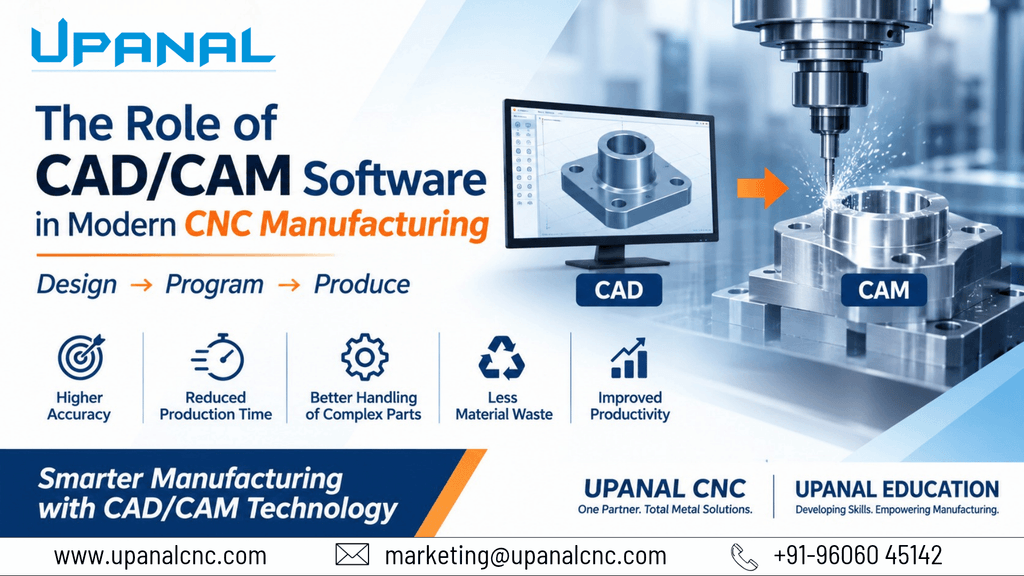
CAD (Computer-Aided Design) and CAM (Computer-Aided Manufacturing) software help manufacturers convert product designs into accurate machining instructions. When integrated with CNC machines, these technologies simplify production processes, improve machining accuracy and support complex component manufacturing.
At the same time, the growing use of CAD/CAM technology has increased the demand for skilled professionals who understand CNC programming and manufacturing processes. Both advanced machine technology and technical education are important for the future of manufacturing.
What Is CAD/CAM Software?
CAD/CAM software combines two important manufacturing processes:
CAD (Computer-Aided Design): Used to create detailed 2D drawings and 3D models of components.
CAM (Computer-Aided Manufacturing): Converts these designs into toolpaths and CNC programs that guide machine operations.
Together, CAD and CAM create a smooth connection between product design and actual manufacturing, helping manufacturers move from digital designs to finished components.
1. Improved Machining Accuracy
One of the biggest advantages of CAD/CAM software is improved machining precision. Digital models and programmed toolpaths help reduce manual programming errors and ensure components are manufactured according to design specifications.
This is particularly useful when manufacturing complex components that require tight tolerances, accurate dimensions and consistent quality.
2. Reduced Production Time
Traditional manual programming can be time-consuming, especially for complicated components. CAD/CAM software automates several programming activities, helping CNC operators prepare machining programmes more efficiently.
Optimized toolpaths can also reduce unnecessary tool movements, cutting time and overall production cycles.
This allows manufacturers to improve machine utilization and increase production capacity.
3. Better Manufacturing of Complex Components
Modern industries require components with complex geometries and intricate designs. CAD/CAM software makes it easier to program advanced machining operations involving multiple axes.
It supports applications involving:
- Vertical Machining Centers (VMC)
- Horizontal Machining Centers (HMC)
- CNC Turning Centers
- 4-Axis and 5-Axis Machining Centers
- Double Column Machining Centers
- Vertical Turning Lathes (VTL)
This allows manufacturers to handle demanding machining applications with greater flexibility and precision.
4. Reduced Material Waste
Efficient toolpath planning and machining simulation help manufacturers identify potential errors before actual production begins.
For sheet metal applications, nesting software can arrange components efficiently on metal sheets, helping reduce scrap material and improve material utilization.
Better material planning also contributes to lower production costs and improved manufacturing efficiency.
5. Improved Toolpath Optimization
CAM software helps generate optimized machining paths based on cutting tools, material types and machining requirements.
Proper toolpath planning can help:
- Reduce unnecessary tool movements.
- Improve cutting efficiency.
- Minimize tool wear.
- Maintain consistent machining quality.
- Improve overall machine utilization.
These improvements help manufacturers achieve better production performance.
6. Simulation Before Actual Machining
One of the most valuable features of modern CAD/CAM software is machining simulation.
Before sending a programme to the CNC machine, manufacturers can simulate machining operations to identify potential tool collisions, programming errors and machining issues.
This helps reduce setup mistakes, material wastage and unexpected machine stoppages.
Simulation is particularly useful for complex machining operations and multi-axis CNC applications.
7. Better Production Planning and Flexibility
CAD/CAM software allows manufacturers to modify designs and machining programmes more easily when product requirements change.
This is especially beneficial for industries handling customized components, small-batch production and frequent design modifications.
Manufacturers can respond more quickly to customer requirements while maintaining production consistency.
How CAD/CAM Software Works with Different CNC Machines
CAD/CAM technology supports various CNC machining and metal fabrication applications.
VMC and HMC Machines: Used for milling, drilling, boring and complex component machining.
CNC Turning Machines: Used to generate toolpaths for cylindrical components and precision turning operations.
4-Axis and 5-Axis Machines: Help program complex geometries and machine multiple surfaces with fewer setups.
Double Column Machining Centers: Support programming for large components used in heavy engineering and industrial manufacturing.
Laser Cutting Machines: CAD-based drawings and CAM or nesting software help prepare cutting layouts and machine instructions for sheet metal processing.
CNC Press Brakes: Suitable offline programming and bending software help prepare bending sequences and improve fabrication planning.
Why CAD/CAM Integration Matters for Indian Manufacturing
As Indian manufacturing industries move towards advanced production technologies, CAD/CAM integration is becoming increasingly important.
Automotive, aerospace, defence, electrical equipment and general engineering industries require consistent quality, faster production and improved manufacturing efficiency.
By combining advanced CNC machines with suitable CAD/CAM software, manufacturers can improve production capabilities, reduce errors and remain competitive in the evolving industrial landscape.
Building Future Manufacturing Skills with Upanal Education
Modern CNC manufacturing requires skilled professionals who understand machine operations, programming, engineering drawings and advanced manufacturing technologies.
Recognizing the growing demand for skilled CNC professionals, Upanal Education provides industry-oriented CNC training for students who aspire to build careers in the manufacturing sector.
Through technical learning and practical exposure, students gain an understanding of CNC technology, machining processes and the skills required in modern manufacturing environments.
Our training initiatives focus on:
- CNC machine operation and programming fundamentals.
- Understanding engineering drawings and manufacturing processes.
- CAD/CAM concepts and applications.
- Practical exposure to CNC machining.
- Industry-oriented technical skill development.
By connecting technical education with real manufacturing requirements, Upanal Education aims to bridge the gap between academic learning and industry expectations.
Our objective is to develop skilled professionals who can contribute to the growing CNC and precision manufacturing industry.
How Upanal CNC Supports Modern Manufacturing
At Upanal CNC, we provide advanced metal cutting and metal forming solutions to support the evolving needs of Indian manufacturing industries.
Our solutions include:
Metal Cutting Solutions:
- Vertical Machining Centers (VMC)
- Horizontal Machining Centers (HMC)
- CNC Turning Centers
- Vertical Turning Lathes (VTL)
- 4-Axis and 5-Axis Machining Centers
- Double Column Machining Centers
Metal Forming Solutions:
- Fiber Laser Cutting Machines
- CNC Press Brakes
- Turret Punching Machines
- Busbar Processing Machines
With advanced machine technology, application support and industry-oriented training through Upanal Education, we aim to support manufacturers and develop the next generation of skilled manufacturing professionals.
Conclusion
CAD/CAM software has become an important part of modern CNC manufacturing. From design development and toolpath generation to machining simulation and production optimization, it helps manufacturers achieve better control over their production processes.
However, technology alone is not enough. Skilled professionals who understand these technologies are equally important for successful manufacturing operations.
By bringing together advanced machine solutions through Upanal CNC and technical skill development through Upanal Education, we aim to contribute to a stronger and more skilled manufacturing ecosystem in India.
Upanal CNC – One Partner. Total Metal Solutions.
Upanal Education – Developing Skills. Empowering Manufacturing.