
The Role of CNC Machines in EV Component Manufacturing
Introduction
The electric vehicle (EV) industry is transforming the automotive manufacturing sector. With the growing demand for electric cars, two-wheelers, commercial vehicles and battery-powered transportation, manufacturers are looking for advanced technologies that deliver precision, productivity and consistent quality.
CNC (Computer Numerical Control) machines play an important role in EV component manufacturing by enabling manufacturers to produce complex components with high accuracy, repeatability and efficiency.
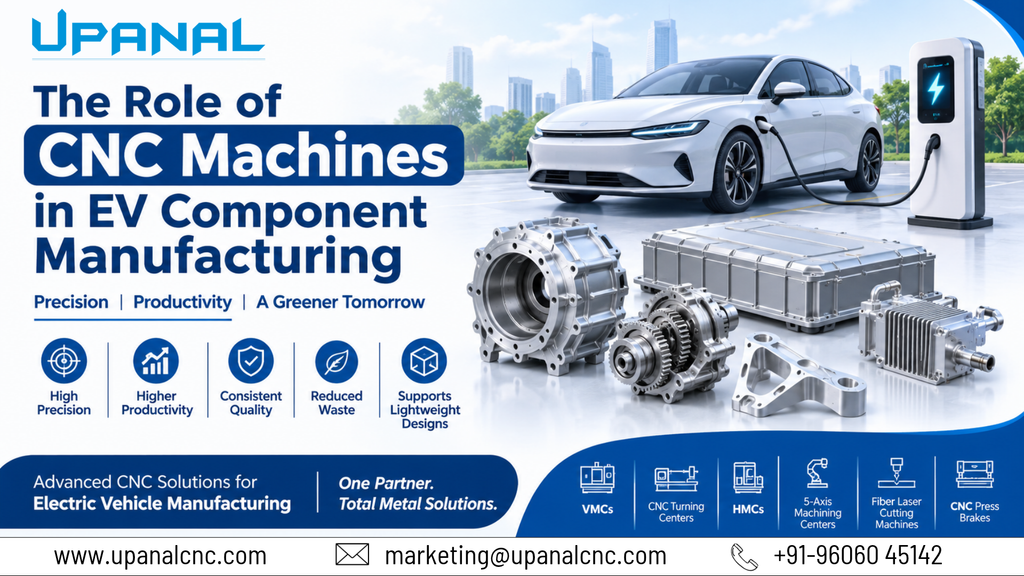
From motor housings and transmission components to battery enclosures and structural parts, CNC machining supports the production of critical EV components.
1. Why CNC Machining Is Important for EV Manufacturing
Electric vehicles require components that meet strict dimensional tolerances and quality standards. Even minor manufacturing variations can affect component performance, efficiency and reliability.
CNC machines help manufacturers achieve:
- High dimensional accuracy and repeatability.
- Consistent component quality.
- Better production efficiency.
- Reduced material wastage.
- Improved machining of complex geometries.
- Flexibility for different component designs.
2. Key EV Components Manufactured Using CNC Machines
Electric Motor Housings
Electric motor housings require accurate machining to ensure proper alignment, fitment and heat dissipation. CNC Turning Centers and Vertical Machining Centers help manufacture these components with precision.
Battery Enclosures and Housings
Battery packs require strong and accurately fabricated enclosures to protect battery modules. CNC machining and advanced laser cutting technologies help manufacture enclosure components with precise dimensions.
Transmission and Gearbox Components
EV drivetrains require precision-engineered shafts, gears and housings. CNC Turning Centers and Machining Centers support accurate production of these components.
Aluminium Structural Components
Lightweight aluminium components are widely used in EV manufacturing to improve vehicle efficiency and range. CNC machining enables manufacturers to produce complex aluminium parts with excellent dimensional consistency.
Cooling System Components
EV battery and motor cooling systems require accurately manufactured manifolds, connectors and housings. CNC machining helps achieve the precision required for reliable assembly.
3. CNC Machines Used in EV Component Manufacturing
Different CNC technologies support different EV manufacturing requirements.
Vertical Machining Centers (VMC): Used for machining motor housings, aluminium components, brackets and complex structural parts.
CNC Turning Centers: Suitable for manufacturing shafts, bushings, cylindrical components and precision drivetrain parts.
Horizontal Machining Centers (HMC): Ideal for machining complex components requiring multiple operations and efficient production workflows.
5-Axis Machining Centers: Help manufacture complex geometries and components that require machining from multiple angles.
Fiber Laser Cutting Machines: Used for cutting sheet metal components, battery enclosures, electrical cabinets and other fabricated parts.
CNC Press Brake Machines: Used for bending sheet metal components used in EV enclosures, mounting structures and protective covers.
4. Benefits of Advanced CNC Technology in EV Production
As EV manufacturing volumes increase, manufacturers need reliable and efficient production systems.
Advanced CNC machines offer several advantages:
- Precision Manufacturing: Helps maintain tight dimensional tolerances.
- Higher Productivity: Reduces manual intervention and improves machining efficiency.
- Lightweight Component Production: Supports machining of aluminium and other lightweight materials.
- Production Flexibility: Allows manufacturers to adapt to changing component designs.
- Consistent Quality: Helps maintain repeatability across production batches.
- Reduced Manufacturing Waste: Optimised machining strategies help improve material utilisation.
5. The Future of CNC Machining in the EV Industry
The EV industry is continuously evolving with advancements in battery technology, electric motors, power electronics and lightweight vehicle structures.
Manufacturers are increasingly adopting automation, multi-axis machining, advanced CNC controls and smart manufacturing technologies.
These developments will make CNC machining even more important in producing high-quality EV components while supporting faster production cycles and improved manufacturing efficiency.
6. Choosing the Right CNC Machine for EV Component Manufacturing
Selecting the right machine depends on several factors:
- Component size and material.
- Required machining accuracy.
- Production volume.
- Number of machining operations.
- Spindle speed and machine capacity.
- Automation requirements.
- Future production expansion.
Manufacturers should evaluate their current production requirements and long-term business goals before investing in CNC technology.
Conclusion
CNC machines are becoming an essential part of the electric vehicle manufacturing ecosystem. From precision motor housings and drivetrain components to battery enclosures and structural parts, advanced CNC technology helps manufacturers achieve better accuracy, productivity and production consistency.
As India’s EV industry continues to grow, investing in the right CNC machining and metal fabrication solutions can help manufacturers stay competitive and meet evolving industry requirements.
Upanal CNC – One Partner. Total Metal Solutions.
With advanced CNC machining, metal cutting and metal forming solutions, Upanal CNC supports manufacturers in building efficient and future-ready production capabilities.
Explore Upanal CNC’s range of VMCs, CNC Turning Centers, Horizontal Machining Centers, 5-Axis Machining Centers, Fiber Laser Cutting Machines and CNC Press Brakes.
Contact Upanal CNC to explore the right manufacturing solution for your business.