
What Is a Horizontal Machining Center and When Should You Use One?
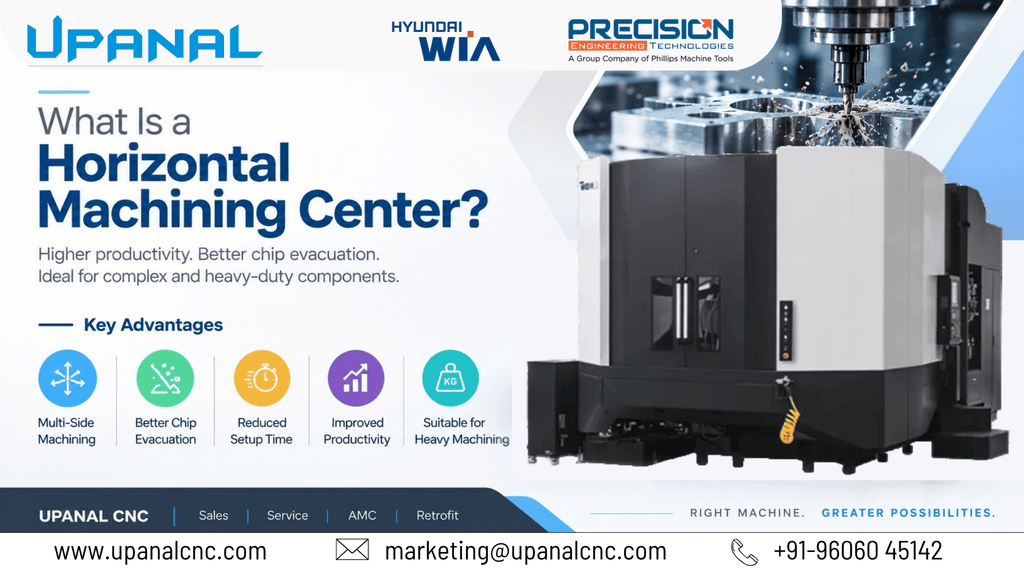
In modern manufacturing, machining accuracy, productivity, cycle time, and machine utilization play a major role in determining production efficiency. For manufacturers working with complex components, heavy-duty materials, or multiple machining faces, selecting the right CNC machine can make a significant difference.
A Horizontal Machining Center (HMC) is a CNC machine designed with a horizontally oriented spindle. Unlike a Vertical Machining Center (VMC), where the spindle is positioned vertically, an HMC allows the cutting tool to approach the workpiece from the side.
This configuration provides several advantages, particularly for manufacturers machining complex components that require operations on multiple faces.
What Is a Horizontal Machining Center?
A Horizontal Machining Center is a computer-controlled machine tool in which the spindle is positioned horizontally relative to the workpiece.
HMCs are generally equipped with features such as:
- Horizontal spindle configuration
- Automatic Tool Changer (ATC)
- CNC control system
- Pallet changer or multiple-pallet configuration
- Rotary table for multi-face machining
- High-speed and high-precision positioning
- Automatic coolant and chip management systems
The horizontal spindle arrangement allows chips generated during machining to fall away from the cutting area more effectively. This can be particularly useful during heavy machining and high-volume production.
How Does an HMC Work?
The workpiece is mounted on a pallet or rotary table inside the machine. The CNC program controls the movement of the spindle, cutting tools, and axes to perform the required machining operations.
Depending on the machine configuration, an HMC can perform operations such as:
- Milling
- Drilling
- Tapping
- Boring
- Reaming
- Threading
- Contouring
With a rotary table or fourth axis, manufacturers can machine multiple sides of a component with fewer setups.
This can help reduce workpiece repositioning, setup time, and alignment errors.
Key Advantages of a Horizontal Machining Center
1. Multi-Side Machining
One of the major benefits of an HMC is its ability to machine multiple faces of a component.
Instead of removing the component and manually repositioning it for every operation, the machine can rotate the workpiece and access different faces.
This is particularly useful for components such as:
- Automotive parts
- Die and mould components
- Pump and valve bodies
- Hydraulic components
- Gearbox housings
- Engineering components
2. Better Chip Evacuation
Because the spindle is horizontal, chips can fall away from the cutting zone more naturally.
Effective chip evacuation can help reduce:
- Chip accumulation
- Recutting of chips
- Tool interference
- Heat buildup
- Surface-finish problems
This becomes especially important during heavy cutting and continuous production.
3. Reduced Setup Time
When multiple operations can be completed in a single setup, manufacturers can reduce the number of times a component needs to be removed and repositioned.
Fewer setups can result in:
Less setup time → Better machine utilization → Higher productivity
It can also improve consistency because the component remains referenced to the machine for more operations.
4. Improved Productivity
HMCs are commonly used in production environments where a large number of similar or related components need to be machined.
Features such as:
- Automatic Tool Changers
- Pallet changers
- Rotary tables
- High-speed rapids
- CNC automation
can help manufacturers achieve shorter production cycles and better machine utilization.
5. Suitable for Heavy Machining
Many HMCs are designed for rigid cutting and heavy-duty machining applications.
They can be suitable for components requiring significant material removal, particularly when the machine has appropriate:
- Spindle power
- Spindle torque
- Machine rigidity
- Workpiece capacity
- Tooling configuration
The correct combination of these specifications is important when selecting an HMC for heavy machining.
HMC vs VMC: What Is the Difference?
Both HMCs and VMCs are widely used CNC machining centers, but their configurations and ideal applications differ.
| Feature | HMC | VMC |
| Spindle orientation | Horizontal | Vertical |
| Multi-face machining | Excellent with rotary/pallet systems | Possible with suitable fixtures |
| Chip evacuation | Generally better | Depends on machining operation |
| Heavy machining | Well suited for many applications | Suitable depending on machine |
| Production machining | Highly suitable | Suitable |
| Complex components | Excellent for multi-face work | Excellent for many 3-axis applications |
| Setup flexibility | High | High |
| Initial investment | Generally higher | Generally lower |
The choice between an HMC and VMC should depend on the component geometry, production volume, machining operations, material, accuracy requirements, and required automation.
When Should You Use a Horizontal Machining Center?
An HMC can be a suitable choice when your manufacturing requirements include one or more of the following:
High Production Volumes
If you are producing large quantities of similar components, an HMC can help improve production efficiency through automation and reduced setup requirements.
Components Requiring Multiple-Side Machining
If a component needs machining on several faces, an HMC with a rotary table or pallet system can reduce the need for repeated setups.
Heavy Material Removal
For applications involving significant material removal, machine rigidity, spindle torque, and chip evacuation become important considerations.
Complex Components
Components with multiple holes, pockets, bores, and machined surfaces can benefit from the multi-axis capabilities available on many HMC configurations.
Reduced Setup Requirements
If your current process requires frequent component repositioning, an HMC may help consolidate multiple operations into fewer setups.
Important Factors to Consider Before Buying an HMC
Choosing an HMC should not be based only on spindle speed or machine size. Manufacturers should evaluate the complete production requirement.
1. Workpiece Size and Weight
Check the maximum component dimensions and weight that the machine can safely accommodate.
2. Spindle Power and Torque
Spindle power and torque should match the material and cutting conditions required for your applications.
3. Pallet Size
The pallet should provide enough working area for your components and fixtures.
4. Axis Travel
Review X, Y, and Z-axis travel according to your component dimensions and machining requirements.
5. Tool Capacity
The required number of tools depends on the number of operations and component complexity.
6. Rotary Table
For multi-face machining, the rotary table configuration and indexing accuracy are important considerations.
7. CNC Control
The CNC control should support the programming, automation, probing, and production requirements of your shop.
8. Automation Requirements
For high-volume production, consider options such as:
- Pallet changers
- Robotic loading
- Automatic tool management
- Workpiece probing
- Tool monitoring
HMC Applications Across Industries
Horizontal Machining Centers are used across several manufacturing sectors, including:
Automotive: Engine components, transmission parts, housings, and other precision components.
Aerospace: Complex structural and mechanical components requiring high accuracy.
General Engineering: Heavy-duty and precision-machined components.
Pump & Valve Manufacturing: Valve bodies, pump housings, and components requiring multiple-face machining.
Die & Mould: Complex components requiring multiple machining operations.
Industrial Equipment: Gearbox housings, machine components, and heavy engineering parts.
HMC Machine Selection: Look Beyond the Machine
Selecting the right machining center is only one part of improving manufacturing productivity.
Manufacturers should also consider:
- Application engineering
- Tooling selection
- Fixture design
- Cutting parameters
- Machine installation
- Operator training
- Preventive maintenance
- Service support
- Spare parts availability
A machine that matches the application and is properly supported can provide better long-term production performance.
Final Thoughts
A Horizontal Machining Center can be an effective solution for manufacturers looking for higher productivity, multi-face machining capability, reduced setups, and efficient chip evacuation.
However, an HMC is not automatically the right choice for every application. The decision should be based on component geometry, material, production volume, machining operations, accuracy requirements, machine capacity, and automation needs.
Before investing in an HMC, evaluate your current production process and identify where setup time, machining time, or repeated component handling can be reduced.
Looking for the Right CNC Machining Solution?
At Upanal CNC Solutions, we provide CNC machining solutions for different manufacturing requirements, including Horizontal Machining Centers, Vertical Machining Centers, CNC Turning, VTL, 5-axis machining, and other precision manufacturing solutions.
One Partner. Total Metal Solutions. Contact Upanal CNC Solutions to discuss your machining requirements and identify a suitable CNC solution for your production needs.