
Why Machine Selection Matters More Than Machine Price
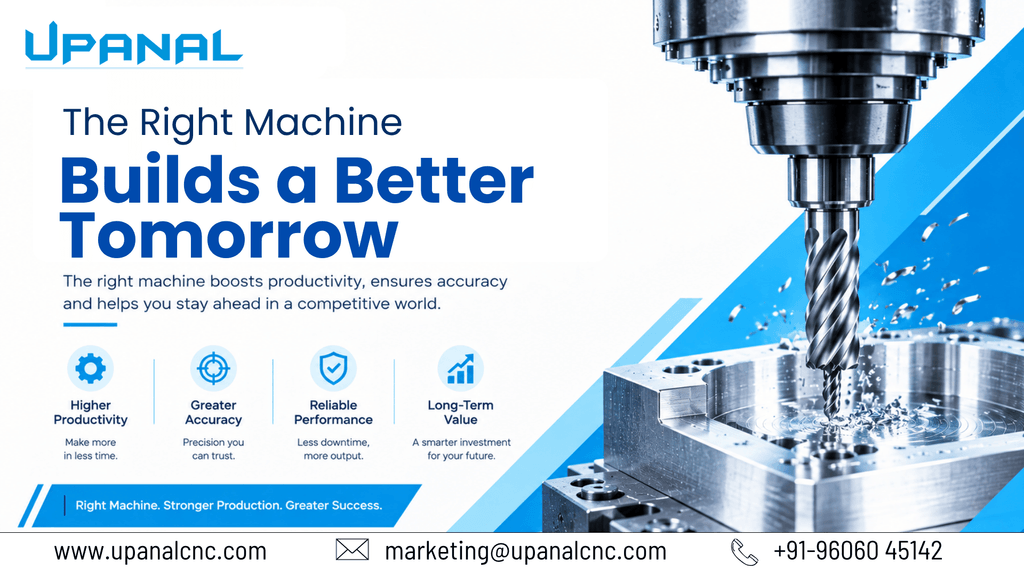
When investing in a CNC machine or metalworking equipment, one of the first questions manufacturers ask is:
“How much does the machine cost?”
Price is certainly important. But focusing only on the initial purchase price can lead to higher production costs, lower productivity and unexpected downtime in the long run.
The better question is:
“Is this the right machine for my production requirements?”
The right machine should match your component, material, production volume, accuracy requirements, cycle time, tooling, automation needs and future business plans.
In manufacturing, the right machine can be more valuable than the cheapest machine.
1. The Cheapest Machine May Not Be the Most Economical
Two machines may appear similar on paper but deliver very different results in actual production.
A lower-priced machine may have limitations in:
- Spindle speed and power
- Machine rigidity
- Work envelope
- Tool capacity
- Automation options
- Control features
- Accuracy and repeatability
- Service support
If these limitations affect production, the initial saving can quickly disappear through longer cycle times, increased tool wear, more frequent maintenance or higher rejection rates.
Machine cost is a one-time investment. Production cost continues every day.
2. Start With the Component, Not the Machine
Machine selection should begin with the job requirement.
Before selecting equipment, manufacturers should evaluate:
- Component size and weight
- Material being processed
- Number of operations
- Required tolerances
- Surface-finish requirements
- Production quantity
- Required cycle time
- Tooling requirements
- Automation requirements
- Future production plans
For example, a component requiring multiple operations may benefit from a machining center capable of completing several operations in a single setup.
The objective is not simply to buy a machine.
The objective is to build an efficient manufacturing process.
3. Cycle Time Directly Impacts Production Capacity
A machine with a lower purchase price may take longer to complete each component.
Consider a simple example:
- Machine A: 20 minutes per component
- Machine B: 14 minutes per component
Although Machine B may require a higher initial investment, its shorter cycle time can provide significantly more production capacity over the machine’s working life.
This is why manufacturers should evaluate cost per component and production capacity, rather than comparing only the machine purchase price.
A machine that produces faster and more consistently can help manufacturers meet growing customer demand without immediately adding another machine.
4. Rigidity and Accuracy Matter
For precision manufacturing, machine rigidity and stability play an important role.
A machine needs to handle cutting forces while maintaining accuracy and repeatability.
Poor machine selection can result in:
- Increased vibration
- Higher tool wear
- Poor surface finish
- Dimensional variation
- Increased rejection
- Inconsistent production quality
Selecting a machine based on the actual machining requirement helps manufacturers maintain consistent production performance.
5. Consider the Material You Work With
Different materials can require different machining and cutting capabilities.
Aluminium, mild steel, stainless steel, cast iron and other engineering materials can have different cutting characteristics and tooling requirements.
Before selecting a machine, manufacturers should consider:
Material + Thickness/Size + Cutting Requirement + Production Volume
The right combination of machine power, spindle characteristics, tooling and cutting parameters can have a direct impact on productivity and tool life.
6. Think About Your Future Production
A machine should not only satisfy today’s requirements.
Your production requirements may change over the next three to five years.
You may introduce:
- Larger components
- New materials
- Higher production volumes
- More complex components
- Additional machining operations
- Automation
- New customer requirements
Choosing equipment with the right capacity and flexibility can help manufacturers avoid replacing or upgrading machinery prematurely.
Think beyond today’s component. Think about tomorrow’s production.
7. Service Support Is Part of the Machine Investment
A machine is valuable only when it is available for production.
Service support, spare-parts availability, preventive maintenance, technical expertise and response time can have a major impact on machine uptime.
When comparing machines, manufacturers should therefore consider:
Machine + Technology + Service + Support
rather than looking at the machine price alone.
A strong service and support system can help reduce unexpected downtime and keep production running more consistently.
8. The Right Machine Depends on the Application
There is no single machine that is perfect for every manufacturing requirement.
The right equipment depends on the component, material, process, production volume, accuracy and future requirements.
Metal Cutting & CNC Machining Solutions
For metal cutting and machining applications, different machines are suited to different production requirements.
VMC – Vertical Machining Center
VMCs are versatile machines used for operations such as:
- Milling
- Drilling
- Tapping
- Pocketing
- Contouring
They can be suitable for a wide range of general engineering and precision machining applications.
HMC – Horizontal Machining Center
HMCs are designed for efficient machining of multiple faces of a component and can be particularly useful for higher-production applications.
Their horizontal spindle configuration and pallet systems can help reduce setup time and improve production flow.
CNC Turning
CNC turning machines are primarily used for cylindrical and rotational components.
Applications can include:
- Shafts
- Bushes
- Flanges
- Pins
- Sleeves
- Other rotational components
The right turning machine can help achieve consistent dimensions and efficient cycle times.
VTL – Vertical Turning Lathe
VTLs are suitable for larger and heavier rotational components.
Their vertical configuration can provide advantages when handling components that are large in diameter or difficult to handle on conventional turning machines.
5-Axis Machining
5-axis machining can be useful for complex components with multiple surfaces, intricate geometries and difficult-to-reach features.
By reducing the number of setups required, 5-axis machining can help improve accuracy and reduce setup-related production time.
Double Column Machining Centers
For large and heavy components, double-column machining centers provide a larger machining envelope and suitable structural support for demanding applications.
9. Sheet Metal Cutting & Forming Also Requires the Right Technology
Machine selection is equally important in sheet-metal manufacturing.
Different production requirements may call for different technologies.
Fiber Laser Cutting
Fiber laser machines are used for precise and efficient cutting of sheet metal.
The right laser cutting system should be selected based on factors such as:
- Material type
- Sheet thickness
- Sheet size
- Production volume
- Required cutting speed
- Accuracy requirements
CNC Turret Punching
CNC turret punching can be used for efficient punching, hole-making and forming operations in sheet metal.
It can be particularly useful when a component requires multiple punching and forming features.
Press Brake
Press brakes are used for accurate bending and forming of sheet-metal components.
Machine selection should consider:
- Bending length
- Tonnage
- Material thickness
- Component geometry
- Required accuracy
- Production volume
Busbar Processing
For electrical applications, dedicated busbar processing equipment can provide accurate cutting, punching and processing of copper and aluminium busbars.
10. Calculate the Total Cost of Ownership
A better way to compare machines is to consider the Total Cost of Ownership (TCO).
This can include:
**Purchase Cost
- Installation
- Tooling
- Energy Consumption
- Maintenance
- Spare Parts
- Labour
- Downtime
- Production Losses**
A machine with a higher initial investment may provide better long-term value if it delivers higher productivity, reliability and production efficiency.
The real question is not:
“How much does the machine cost?”
It is:
“How much will this machine cost to operate and how much value can it generate?”
11. Productivity Should Be Part of the Buying Decision
When selecting a machine, manufacturers should look beyond specifications and consider actual production performance.
Important factors include:
- Cycle time
- Machine utilization
- Setup time
- Tool-changing time
- Loading and unloading time
- Automation possibilities
- Operator requirements
- Maintenance requirements
- Expected uptime
A machine that fits smoothly into the production process can help reduce bottlenecks and improve overall manufacturing efficiency.
12. Ask These Questions Before Buying
Before finalizing a machine, ask:
1. What components will we manufacture?
Understand the component size, geometry, material and complexity.
2. What production volume do we require?
A low-volume job and a high-volume production line may require completely different machine configurations.
3. What accuracy and surface finish are required?
The machine should be capable of consistently achieving the required quality.
4. What cycle time do we need?
Cycle time directly affects production capacity and cost per component.
5. Can the machine handle future requirements?
Consider expected changes in component size, material, volume and complexity.
6. What tooling and automation will be required?
The machine should integrate effectively with your tooling and production process.
7. What service and spare-parts support is available?
Reliable technical support is an important part of machine ownership.
8. What is the total cost per component?
This provides a better basis for comparison than purchase price alone.
13. Machine Selection Is a Production Decision
Choosing a machine is not simply a purchasing activity.
It affects almost every part of manufacturing:
Productivity → Quality → Cycle Time → Downtime → Operating Cost → Customer Delivery
A machine that is correctly matched to the application can help create a more efficient and reliable production process.
This is why manufacturers should evaluate the complete solution rather than selecting equipment based only on the lowest quotation.
Conclusion
Buying a CNC machine or metalworking system is a long-term production investment.
The lowest-priced machine may appear attractive initially, but the right machine can have a much greater impact on productivity, quality, uptime and overall manufacturing cost.
Instead of asking:
“Which machine costs less?”
Manufacturers should ask:
“Which machine is right for my production?”
The answer depends on the application, material, component, production volume, accuracy, cycle time, automation and service support.
From metal cutting and forming, the right technology begins with understanding the manufacturing requirement.
Looking for the right metalworking solution?
Upanal CNC Solutions – One Partner. Total Metal Solutions.
We help manufacturers explore solutions across metal cutting and metal forming, based on their production requirements.
Because the right machine is not necessarily the cheapest machine — it is the machine that delivers the right value over its working life.